
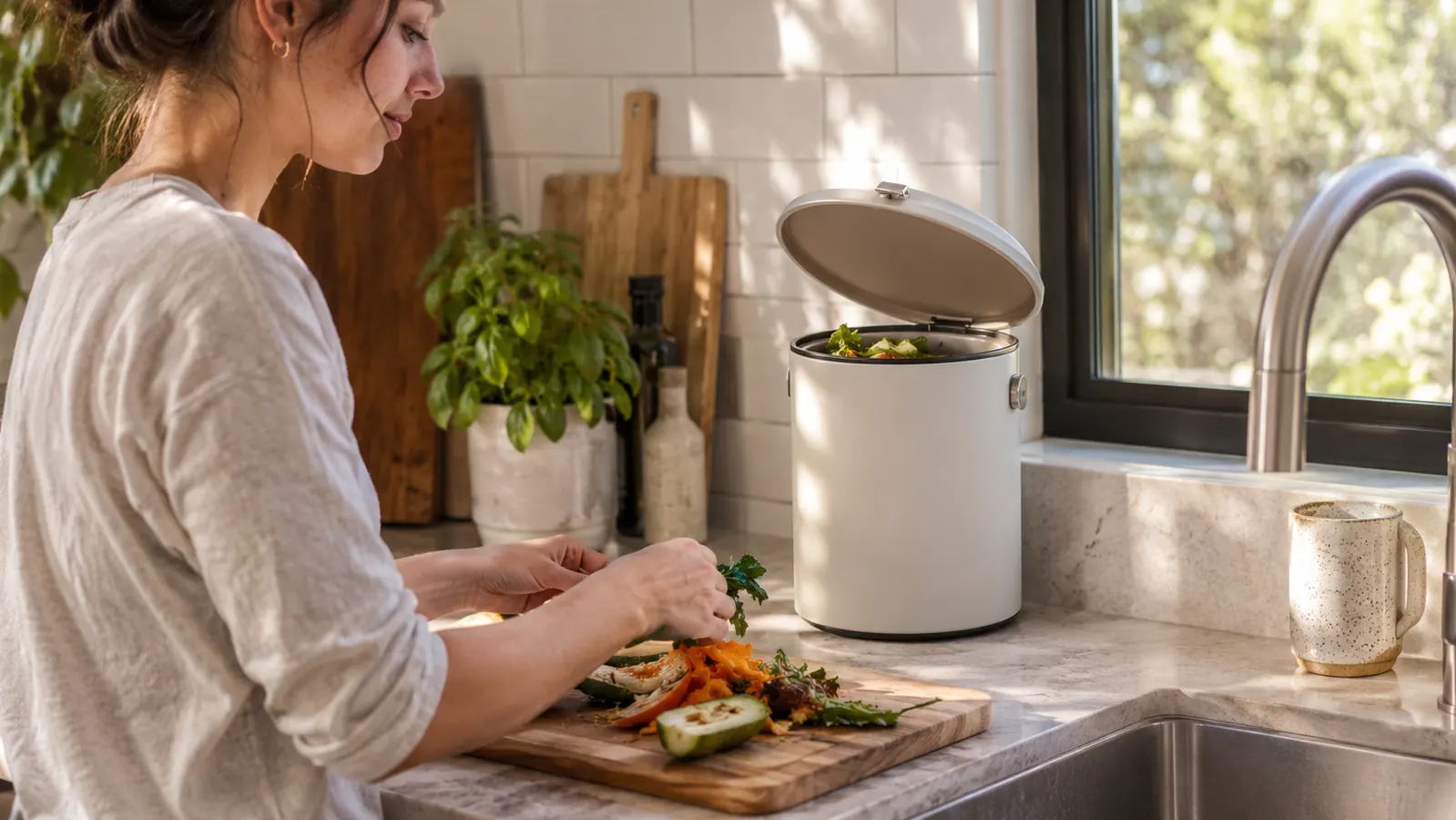
The Epica countertop compost bin has been sitting to the left of my kitchen sink since last March, and I should be honest about why I bought it. My granddaughter Nora is fifteen and she started a one-girl audit of my kitchen after a school project on landfill waste. She found the coffee grounds, the eggshells, the ends of the zucchini I grow out back, all of it going into a plastic bag and then into the truck. She was not rude about it, which was worse. So I bought a stainless bin, set it on the counter, and gave it one season to prove itself. This is the honest account of how that went, including the parts a product page would leave out.
Most write-ups on this bin tell you it holds 1.3 gallons, that it has a charcoal filter, and that it looks tidy on a counter. All of that is true. What they tend to skip is the part that decides whether you are still using it in August, when the tomatoes come in faster than you can eat them and the last thing you want is one more chore between you and the door. I have emptied this bin about twice a week for a year, carried it through my split-level house to the pile behind the raised beds, and scrubbed it more often than I planned. Here is what actually happens.
The Quick Verdict
A well-made, genuinely useful counter bin that keeps scraps out of the trash and odour out of the room. It is a holding tank, not a composter, and 1.3 gallons fills fast in harvest season.
Amazon Check Today's Price →It solved the smell. It did not solve the walk outside.
1.3 gallons, just over seven inches across, eleven inches tall, stainless steel with an airtight lid and a replaceable charcoal filter. A week of coffee grounds and vegetable ends without the kitchen announcing it.
Amazon Check Today's Price on Amazon →What the Epica Bin Actually Is
Strip away the marketing and it is a cylinder. Seven and a quarter inches across, eleven inches tall, made of stainless steel, with a lid that seats down and a charcoal filter tucked inside that lid. Capacity is 1.3 gallons, which in my kitchen means roughly a week of coffee grounds, eggshells, and vegetable ends before it needs attention. You lift the lid, you scrape, you set the lid back down. That is the whole interaction, and after a year I have come to think that is the point. Complicated bins get left in cupboards.
The filter is the part worth understanding before you buy. It is activated charcoal, it sits in the lid, and it lasts three to six months depending on how much goes in the bin and how warm the kitchen gets. Epica says to rinse it and let it air dry to stretch its life, and not to saturate it. That advice matters more than it sounds. A soaked filter stops working and starts smelling like the thing it was supposed to fight. I have been through three filters since March, and two of those were my own fault.
The stainless is the other thing people ask about. It wipes clean, it does not stain the way plastic does after a summer of tomato scraps, and it does not hold onto the smell of last week's onions the way the plastic bucket I used before did. It does show water spots if you leave it to air dry, and it collects fingerprints around the lid if your grandchildren are the sort who touch everything. Mine are. A dry cloth takes care of both in about four seconds.
How I've Used It Since Last March
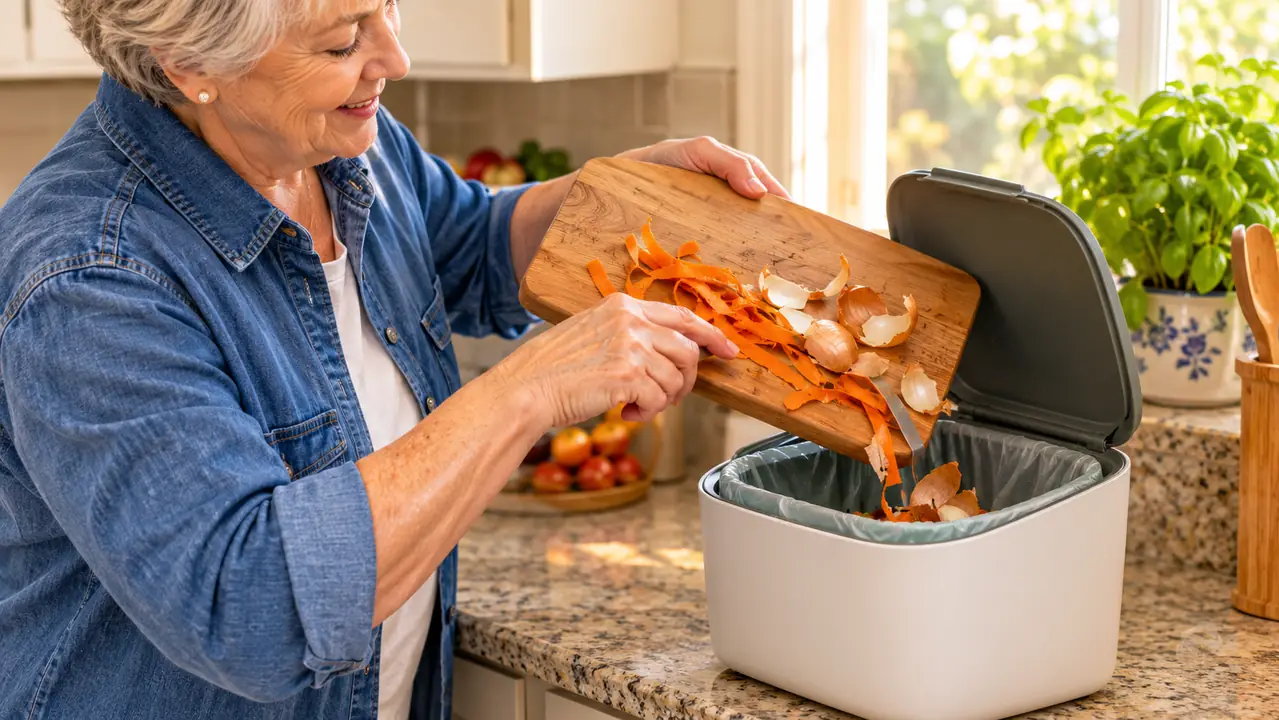
The bin lives on the counter to the left of the sink, which is where the cutting board work happens, and that placement is most of why it works. Anything that required opening a cupboard door would have failed by April. I keep a small bowl on the board while I chop, and the bowl goes into the bin when I am done. Coffee grounds go in straight from the filter basket. Eggshells go in too, though I crush them first, because whole shells take up space and I am stingy about space.
About twice a week I carry it out the back door to the pile behind the raised beds. It is light when it is empty and manageable when it is full, and I have never once worried about the lid coming loose on the stairs. When Caleb is here, which is most weekends, he carries it out for me, partly because he likes being useful and partly because he is twelve and the stairs are not a big deal to him. In July and August, when the zucchini are producing, I go out more often. That is not the bin's fault. That is zucchini.
Cleaning is a rinse and a wipe with hot water and a little dish soap, then air drying on the rack. Every few weeks I do a deeper clean with baking soda, mostly because I like the smell of it, not because the bin demands it. The one rule I would pass along is this. Do not let it sit half full through a warm week. That is when the little fruit flies find it, and once they do they are persistent. A full bin emptied promptly is a boring bin, and a boring bin is what you want on a counter.
The filter does not make the smell vanish. It keeps the smell from travelling. Those are different promises, and only one of them is true.
The Things Nobody Tells You
First, this bin does not compost anything. It stores scraps until you carry them somewhere else. If you have no pile, no tumbler, no municipal pickup and no neighbour with chickens, you have bought a very nice holding tank for a problem you have not actually solved. I have the pile, so for me it works. I want that on the table before anything else, because a counter bin sold as a composting solution will disappoint somebody.
Second, 1.3 gallons is smaller than it sounds in August. In February, when the scraps are coffee grounds and the odd carrot peel, a week is nothing. In August, when the tomatoes are splitting on the vine and the zucchini are doing what zucchini do, I empty it every other day. If you cook a lot of produce, or there are four of you, this is a small bin. It is the right size for me, one person with two grandkids on weekends. It would be tight for a family.
Third, the filter is a consumable, and the three to six month estimate is honest but it assumes you are not careless. Rinse it, air dry it, do not soak it, and put the lid back on when you are done. I got lazy on a hot afternoon in July and left the lid off while I answered the phone. That filter came back to life two days later in a way I did not appreciate. Since then I keep a spare in the drawer under the bin, which costs little and improves my mood considerably.
Fourth, airtight is a mechanical fact, not a promise about your life. The lid seats down and the charcoal does what charcoal does, which is trap odour rather than perfume it. But airtight means the smell stays in the bin, not that the smell never existed. Open the lid over a full bin on a warm day and you will get a faceful. That has been true of every bin I have used, including the expensive ones. If you want a bin you can open without noticing anything, you want something that does not exist.
Fifth, the stainless shows everything. Water spots, a smudge of tomato, a fingerprint on the lid. None of it is damage, and all of it wipes off, but if a spotless kitchen matters more to you than a working one, buy a plastic bin and accept the trade. I have made my peace with the spots. Nora has not, and she wipes it down without being asked, which I have decided to count as a feature.
What I Liked
- Airtight lid and a charcoal filter that keep odour in the bin rather than in the room
- Stainless steel does not stain or hold smells the way a plastic bucket does
- Small footprint at eleven inches tall and just over seven inches across, so it fits beside a sink
- Simple to use: lift the lid, scrape, put it back. Nothing to assemble and nothing to break
- Replaceable filters last three to six months with basic care
Where It Falls Short
- 1.3 gallons fills fast in harvest season, especially for more than two people
- It stores scraps, it does not compost them. You still need somewhere to take them
- Filters are a recurring cost and are ruined by soaking or leaving the lid off in heat
- Stainless shows water spots and fingerprints
- Skip a warm week and you will meet fruit flies
Does It Actually Keep the Smell Down?
This is the question I get asked most, usually by Nora's mother, who is skeptical of anything that lives on a counter. The answer is yes, with a caveat. With a fresh filter and the lid seated, I cannot smell the bin from two feet away. Standing over it with the lid open, yes, you get a smell. That is scrap, and scrap smells. But the kitchen does not smell like scrap, and that is the difference between a bin I keep on the counter and a bin I move to the garage. The caveat is that a tired filter and a full bin in August will test it. Change the filter on schedule and empty the bin when it is full and you will not have a problem.
I tested this more than I meant to. The week my replacement filters were late, I was scraping into a bin with a filter that had been in service since spring, and I noticed the difference by the third day. Not a terrible smell. Just a whisper of one when I walked past. That was enough to make me order two sets the next time. If you are the sort of person who notices a whisper, do the same.
Where It Genuinely Earns Its Counter Space
The honest case for this bin is that it removes the friction that made me quit composting twice before. My old setup was a plastic bucket under the sink. Out of sight, out of mind, and by the time I remembered it, it had become a science project I did not want to open. On the counter, in plain view, next to where I chop, the bin gets used because using it is easier than not using it. That sounds like a small thing. It is the whole thing.
The second case is that it holds its shape and it does not hold a smell. Stainless does not absorb the way plastic does, and a year of tomato ends and onion skins has not left a permanent odour in it. I have owned plastic containers that never recovered from one bad week. This one has recovered from three, and the only thing I replaced was a filter.
The third case is the footprint. Eleven inches tall and a bit over seven wide is a small patch of counter, and it sits under the upper cabinets beside the sink without crowding the coffee maker. I measured before I ordered because my counter is not generous. If yours is tighter than mine, measure twice. That is not a knock on the bin. It is a knock on kitchen design.
Winter is the season I expected to be a problem and was not. In January the bin gets a fraction of what it gets in August, mostly coffee grounds and citrus peels, and I empty it once a week instead of twice. The pile out back freezes and stops working, which is a fact about Colorado and not a fact about the bin. It does mean the scraps sit in a bucket in the garage for a few months before they go anywhere useful. If you garden in a cold climate, plan for that.

What I Would Change
Two things. I would put the filter care instructions inside the lid instead of on a card that ends up in a drawer, because the rinse and air dry rule is the difference between a filter that lasts five months and one that lasts five weeks. And I would make it easier to buy a replacement filter at a hardware store instead of planning ahead online. There was a week in June when I was waiting on a delivery and scraping into a bin with a tired filter, and I noticed. Epica's filter is a small recurring cost, but it is not optional either.
Who This Is For
This bin is for someone who already has somewhere for the scraps to go and needs the kitchen end of the job to stop being unpleasant. A gardener with a pile, a household with municipal collection, a person whose neighbour keeps chickens. It suits a one or two person home that cooks most nights, and it especially suits anyone who has tried the under-sink bucket and quietly given up on it. If you like a tidy counter and you do not mind wiping it down, you will be glad you bought it.
Who Should Skip It
Skip it if you have no destination for the scraps, because a counter bin with nowhere to go becomes a bin of regret. Skip it if you cook for four or more most nights, or if you put up tomatoes every August, because you will be emptying it constantly and you will start to resent the lid. Skip it if you want something you can leave for two weeks without thinking about it. And skip it if paying for replacement filters bothers you, because there is no version of this bin that avoids them.
The Short Version
I have kept this bin on my counter for a year, which is longer than I have kept most kitchen gadgets, and I have already told Nora she can have one when she moves out. It is not perfect. It is small, the filter is a chore to remember, the stainless shows every splash, and it does not compost a single thing. What it does is make the daily habit easy enough that I actually do it, and after two failed attempts with a bucket under the sink, that is the only measure I care about.
Small bin, real habit. That was the trade I made.
Eleven inches tall, 1.3 gallons, stainless steel, airtight lid, charcoal filter that lasts three to six months with care. If you already have a pile out back, this is the kitchen end of the job solved.
Amazon Check Today's Price on Amazon →