
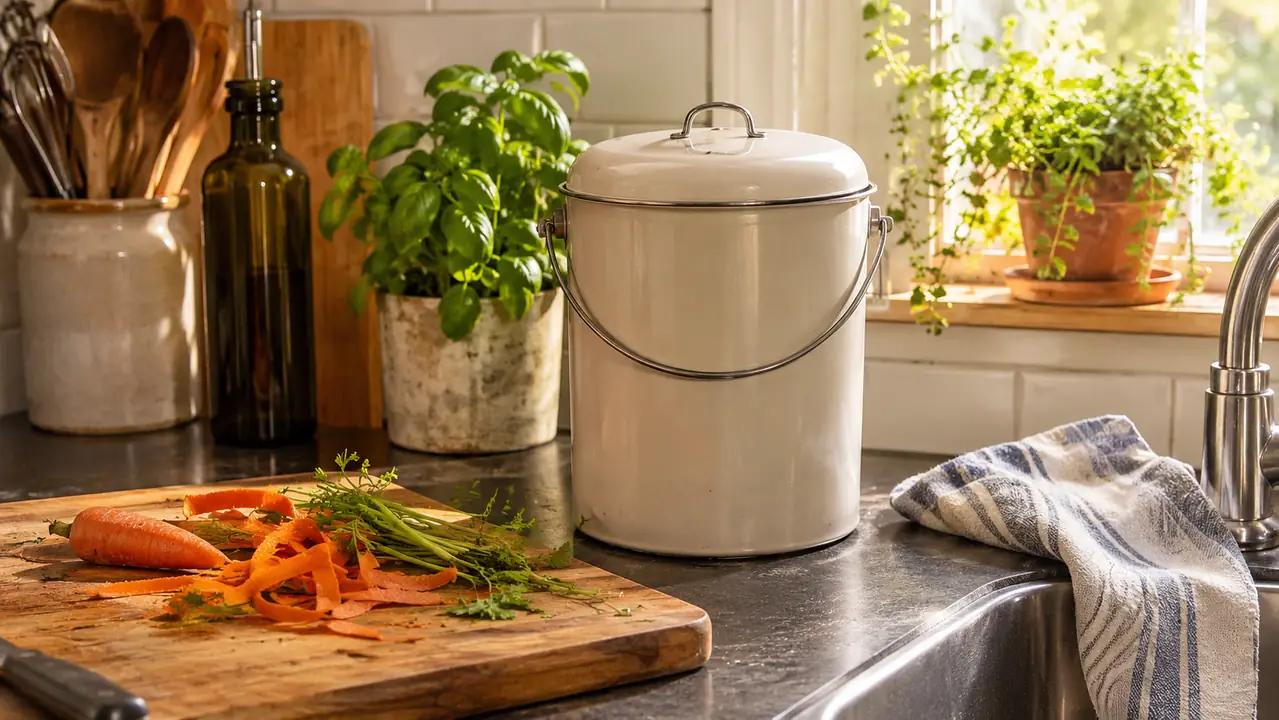
Nora counted my trash. That is the whole story of how a stainless steel bucket ended up on my kitchen counter, just left of the sink, where the utensil crock used to sit. She was fifteen then, going through a phase where she read the city of Loveland recycling rules out loud at the dinner table, and one Tuesday she asked me how many eggshells and coffee grounds I had thrown in the garbage that week. I did not know. That was the answer, really. A woman who has kept a garden for five years and cannot say where her scraps go has not been paying attention.
So I bought the Epica Kitchen Compost Bin last March, a few weeks before I planted the tomatoes, and it has been sitting in that spot ever since. I empty it twice a week into the pile behind the raised beds. My grandson Caleb carries it out for me when he visits, partly because he likes being useful and partly because he is twelve and the lid is satisfying to close. I have used it long enough now to have opinions.
The short answer is this. The Epica is the better bin if smell and mess are what worry you. The Utopia is the better buy if you are not yet sure you will keep the habit up. Both hold kitchen scraps on a counter without inviting fruit flies to move in. The differences come down to the lid, the filter, and how much fuss sits between you and the walk out to the compost pile.
How I Compared Them
I have used the Epica daily since last March, which is more than a year of coffee grounds, eggshells, zucchini ends and the occasional sad tomato. It sits on the counter to the left of the sink. I empty it about twice a week into the pile behind the raised beds, and I swap the charcoal filter every few months, usually when I notice I am thinking about it.
The Utopia Kitchen bin I used for a week in July, house-sitting at my daughter's place in Fort Collins while the family was away at a ball tournament in Denver. Different kitchen, different counter, same job. I scraped plates, I carried it out, I put the lid back on one-handed more times than I can count.
I did not weigh scraps or keep a spreadsheet. I am retired, not running a lab. I paid attention to four things: whether the lid sealed, whether the kitchen smelled, whether the filter was easy to reach and rinse, and whether the bin was something I wanted to look at every day.
I did make a note on the calendar every time I emptied it, which sounds more organized than it was. Mostly it was a scribble on the pad beside the phone. Over the year that came to about twice a week, a little more in August when the zucchini and tomatoes were coming in faster than I could eat them, and less in January, when I am cooking soup out of the freezer.
| Epica | Utopia Kitchen | |
|---|---|---|
| Capacity and footprint | 1.3 gallons, 7.16 inches across and 11 inches tall, so it fits the narrow strip beside the sink | Also built for a counter, and it takes up a similar amount of room |
| Lid and seal | Airtight lid that presses down flush and holds the charcoal filter where the air has to pass | Lid sits on top and closes, though not with that same tight press |
| Odor control | Replaceable activated-charcoal filter, rinsed, air dried, replaced every 3 to 6 months | Has a charcoal filter too, and over one week it held up fine |
| Material | Stainless steel body, cylindrical | Stainless steel body |
| Opening it with one hand full | Takes two hands in practice, so I set the board down first | Lighter lid, easy to flip up and drop back down while the other hand is busy |
| Getting at the filter | Sits under the lid: rinse, air dry, do not saturate it | Similar arrangement, no fuss either way |
| What you spend to find out if you will keep it up | A real little fixture you buy once and leave on the counter for years | Less to lose on an experiment you might abandon by August |
| Looks on an open counter | Plain and cylindrical, reads as part of the kitchen | Also plain, no strong feelings either way |
| Best for | A household filling it twice a week that wants the smell handled | Someone testing the habit, or a light-scrap kitchen |
I should say that I had tried this before. For two summers I kept a plastic bucket with a snap lid under the sink, and it did exactly what a plastic bucket under the sink does, which is to teach you why people give up. The lid never seated, the smell got into the cabinet, and I went back to putting eggshells in the trash. That is the failure any countertop bin has to beat.
Reading that table honestly, the Epica wins the parts that are hard to fix later, namely the seal and the filter routine. The Utopia wins the parts that are easy to fix later, namely what you spend to find out whether you like composting at all.
Where the Epica Wins
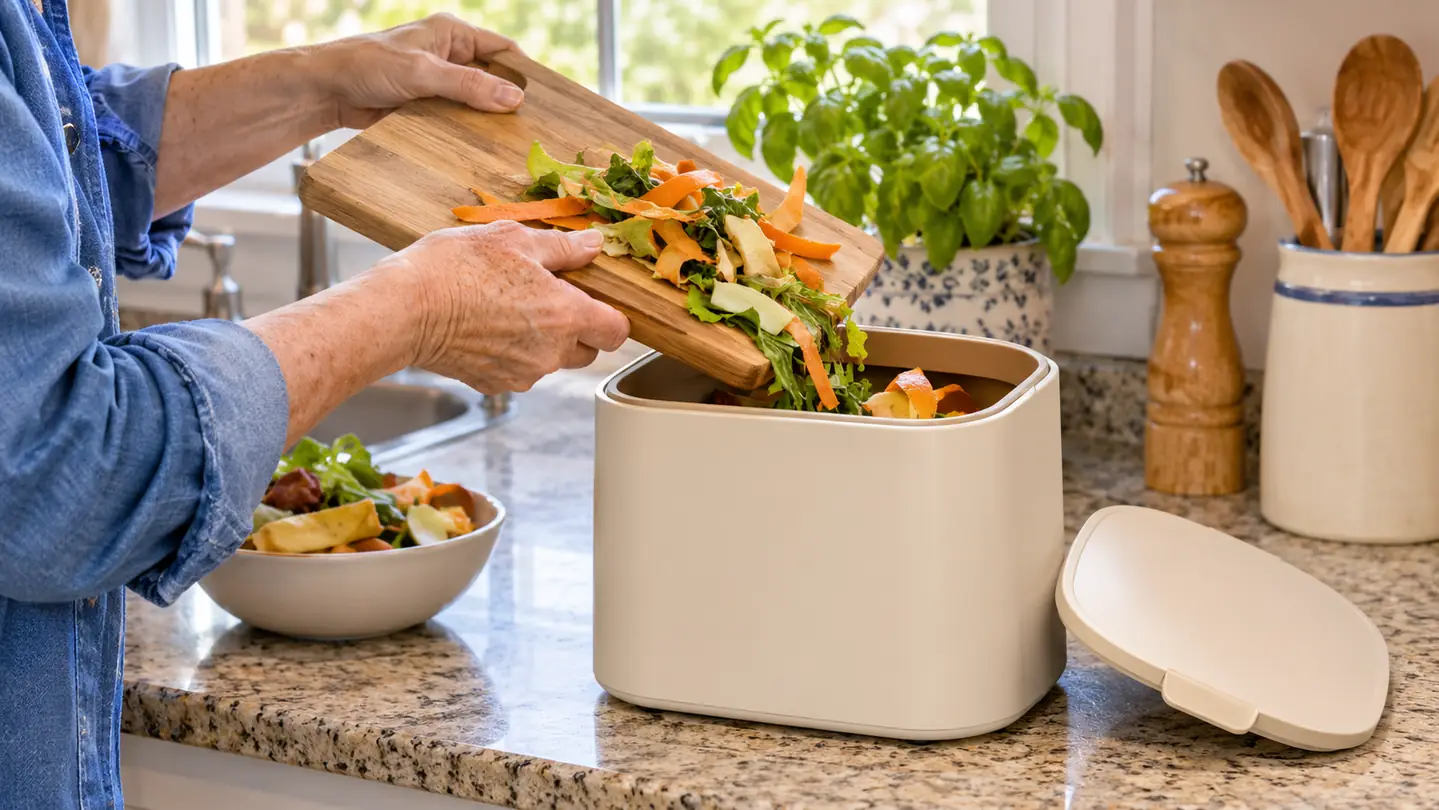
The lid is the reason I would buy it again. It presses down flush and holds the activated-charcoal filter right where the air has to pass through it. In practice that means I can put a week of onion ends and melon rinds in there and the kitchen still smells like a kitchen. I have tested this in August, which in Loveland means the windows are open and the house is warm, and warm is when a compost bin tells the truth about itself.
The test I remember was a Saturday in early August, the day after a big harvest. I had trimmed a whole pile of tomatoes and zucchini and filled the bin close to the rim, then got distracted by a phone call and left it until Monday morning. When I finally opened it, the smell stayed inside the bin. That is not a small thing. That is the whole thing.
The filter needs a little attention. Rinse it, let it air dry, and do not saturate it, because a soaked charcoal filter stops working and starts smelling like the thing it was supposed to prevent. Mine gets replaced every three to six months, which is what the maker says and what my nose confirms. It is a small chore, and it is the difference between a bin and a bucket.
The size is right for one person who cooks. Seven and a quarter inches across and eleven inches tall, 1.3 gallons, cylindrical, so it stands in the narrow strip beside the sink without crowding the dish soap. It is stainless steel, which means it wipes clean and does not hang onto the memory of last week's broccoli. After more than a year it still looks like something I bought this spring.
Carrying it out is not a chore either. It is a small bin, one hand does it, and the lid comes off and goes back on without a production. I tip it onto the pile, knock the sides once, and I am back inside before the screen door settles. Forty steps, twice a week. If it were harder than that I would not do it, and I know that about myself.
Eleven inches tall and seven and a quarter inches across, it holds 1.3 gallons, which is roughly four days of scraps for one person who cooks most nights.
Where the Utopia Wins
The Utopia Kitchen bin is the one I would hand to somebody who is not sure. It does the same basic job for a good deal less, and if you try countertop composting for a month and decide you hate the whole business, you have not spent much to learn that. There is real value in a low-stakes first step. I have watched people buy the nicest version of a thing, fail at it once, and never try again.
It also has the easier lid. I could flick it up and set it back down with my left hand while my right hand held a cutting board, and I never once had to put anything down to do it. On the Epica I set the board on the counter first, lift, scrape, replace. Small thing. It is a small thing you do four times a day, which is how small things turn into big things.
What it does not do as well is the long quiet stretch. The seal is not as tight, and a tight seal is what buys you the back half of the week. If you empty a bin every single day, that hardly matters. If you empty it Sunday and Thursday like I do, it matters quite a lot.
The Lid Is the Whole Argument, and This One Seals
If the reason you gave up last time was the smell, the Epica is the one I would start with. Airtight lid, replaceable charcoal filter, 1.3 gallons, sized for the strip beside the sink. Mine has been running since last March.
Amazon Check Today's Price on Amazon →
The Filter Question, Which Nobody Mentions
Every bin in this category lives or dies on a piece of charcoal the size of a coaster. The Epica's filter is replaceable, and the routine is simple: rinse it, air dry it, put it back, replace it every three to six months. Do not soak it. A saturated filter is worse than no filter at all, because it holds moisture up against the lid and then the lid starts to smell.
I learned that the hard way in June. I rinsed the filter under a running tap instead of giving it a quick pass, set it back damp, and by Thursday the counter smelled like the bottom of the pile. I dried it on the dish rack in the sun for a full afternoon and the problem went away. Now I rinse it in the morning and it dries while I am out in the garden.
Buy a spare and keep it in the drawer with the twist ties and the birthday candles. Then the swap takes thirty seconds and you never find yourself doing it at a bad moment, like the day before Caleb and Nora arrive for their summer week, when the kitchen needs to not smell like a compost pile. That is the whole maintenance story. It is not glamorous, and it is the reason the bin works.
What It Is Actually Like to Live With
The rhythm of it: I cook, I scrape, I close the lid. Twice a week I carry it out back, which is about forty steps from the kitchen door to the pile behind the raised beds. In summer Caleb does it because he likes the job. In February I do it myself in my coat, and I am quick about it.
The pile freezes in February, so I do not turn it, I just add to the top and let it wait until spring. The bin holds about four days of scraps for one person who cooks most nights, which is why twice a week works out. When Nora and Caleb come for their summer week it fills in two days and somebody is walking it out more often. That is fine. That is a house with people in it.
The thing I did not expect was how much it changed what went into the garbage can. Coffee grounds, eggshells, banana peels, carrot tops, the zucchini that got away from me. My kitchen trash is lighter and it does not smell, and the pile behind the beds got bigger, and the tomatoes last summer were the best I have had. That last part might be luck. The lighter trash can is not.
Who Should Buy Which
Buy the Epica if you already know you will keep at it. If you cook most nights, if you have a pile out back or a curbside program, if you have ever opened a countertop bin and regretted it, this is the one I would point you toward. It seals, it holds the smell, and the filter routine is small enough that you will actually do it.
Buy the Utopia if you are testing the habit, or if your household is small and your scraps are light and you would rather not spend more than you have to on a maybe. If you get a month in and find you are emptying it every day, then you know you are a compost person and you can upgrade later. Either way the scraps stop going in the trash, and that was the point Nora was making at my dinner table.
One more thing, since Nora will read this over my shoulder. If you are buying for someone who has been talking about wasting less, do not surprise them with the fanciest bin on the shelf. Buy the cheaper one, or buy nothing and let them ask. The people who keep composting are the ones who decided to, not the ones who were handed a gift with a job attached.
Start With the One That Handles the Smell
The Epica Kitchen Compost Bin has been on my counter since last March. Airtight lid, replaceable charcoal filter, 1.3 gallons, stainless steel. It does the unglamorous part so the garden gets the good part.
Amazon Check Today's Price on Amazon →