
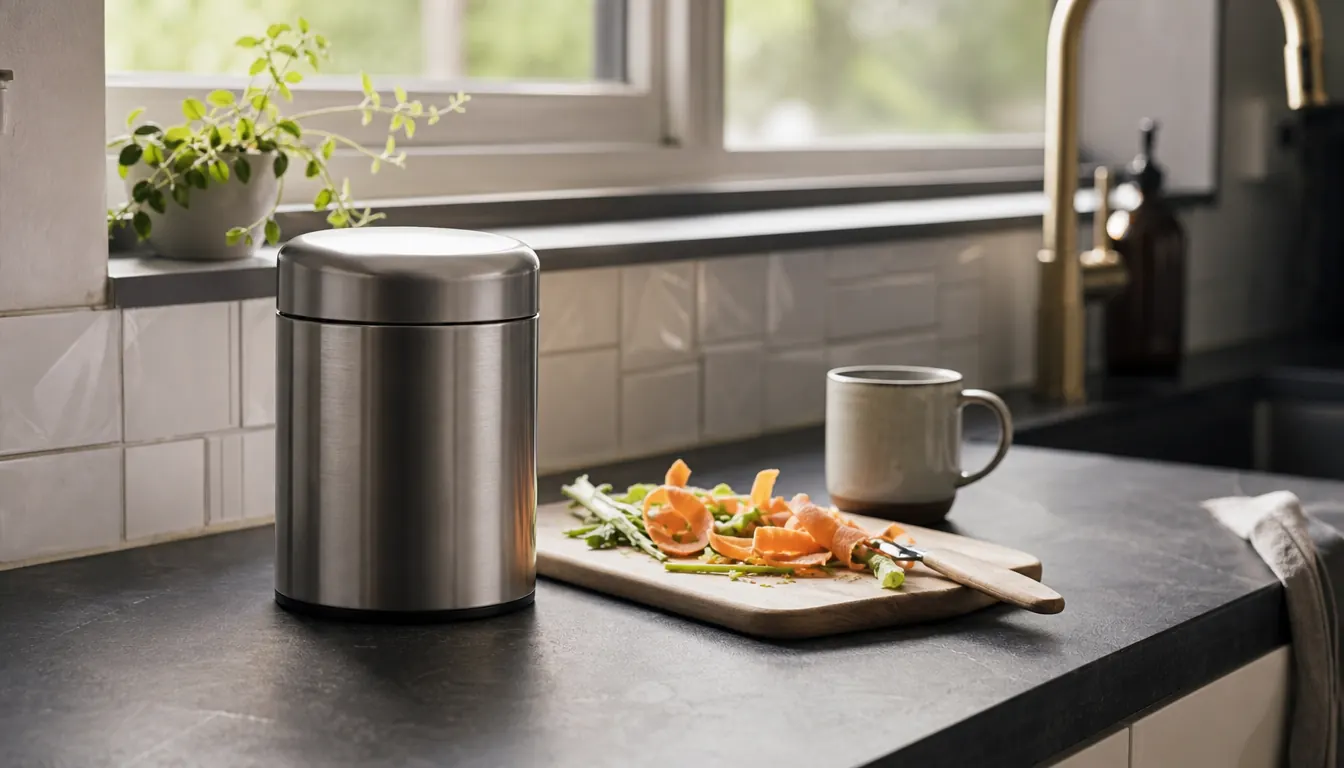
For two years the compost situation in my kitchen was a plastic ice cream pail. It sat on the counter to the left of the sink, it filled up in about three days, and by day two it had opinions. I knew better. My granddaughter Nora, who is fifteen and has appointed herself the recycling police of this family, told me so roughly once a month, usually while standing over the trash can with the lid open and a look on her face I have learned to recognize.
Last March, before planting season, I finally bought the Epica countertop compost bin. It is a stainless steel cylinder, 1.3 gallons, 7.16 inches across and 11 inches tall, with an airtight lid and a replaceable activated charcoal filter set into the top. It has sat in that same corner through a full Colorado gardening season and then some, through tomato sauce in August and a quiet winter of coffee grounds. What follows is what a year of real use actually did to it, the parts that surprised me, and the small ongoing annoyances I would want to know about if I were you.
The Quick Verdict
Airtight, charcoal filtered, and small enough to keep on the counter where you will actually use it. It earned its spot. The filter is a small ongoing cost and a big cooking day will outrun 1.3 gallons.
Amazon Check Today's Price →The counter bin that finally stopped my kitchen smelling like a bucket
Stainless steel, 1.3 gallons, airtight lid, replaceable charcoal filter. It has been on my counter since March and I have never once moved it to the garage.
Amazon Check Today's Price on Amazon →How I've Used It
The Epica bin lives on the counter to the left of the sink, in the corner between the dish rack and the coffee maker. That is roughly two steps from where I do all my chopping, and that distance is the entire reason it works. When I am trimming green beans or scraping a zucchini, the lid comes off, the scraps go in, the lid goes back on, and I go back to what I was doing. A bin that lives under the sink or out in the garage does not get used. I know this because I owned one, and I owned it for two years, and I would like those two years back.
I empty it about twice a week into the compost pile behind the raised beds. When Caleb is over, which is most weekends in summer and one full week in July, that job is his. Partly because he is twelve and needs a job, and partly because he likes the walk and the chance to be outside with a bucket and an excuse to be muddy. The bin is 11 inches tall and 7.16 inches across, so it carries easily in one hand. The first few weeks I carried it out myself. It has never been a heavy lift, even full and even on the mornings when I let it go a day longer than I should have.
Roughly every three months I swap the charcoal filter. In between, I rinse it and set it to air dry on the dish rack. The listing says filters last three to six months and warns against saturating the charcoal. I have kept to that and I have gone through three filters since last March, which puts me toward the short end of the range. I will explain why below, because it is not a defect exactly, but it is a thing you should plan for before you find out the hard way.
What the Bin Actually Does
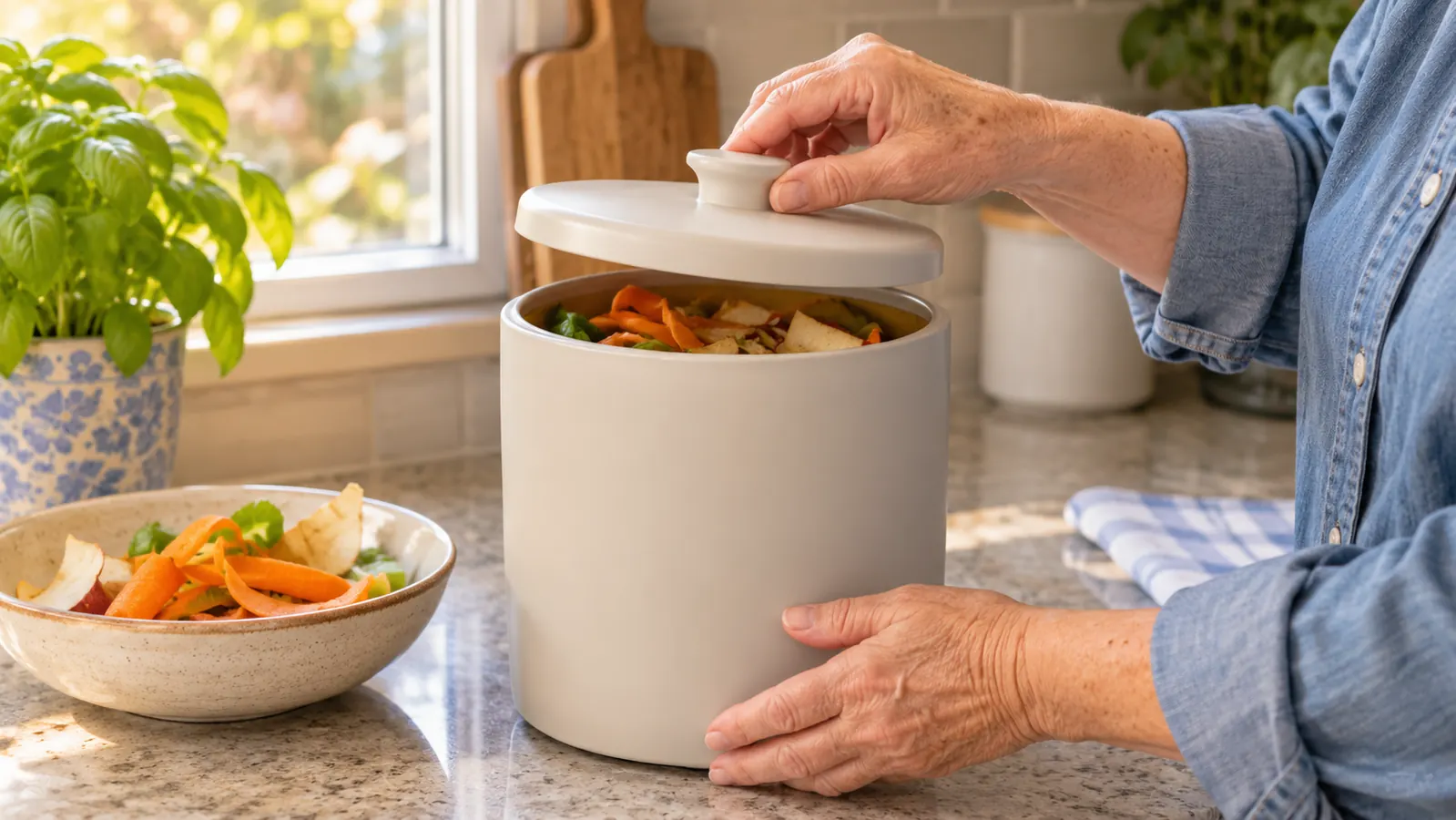
Strip away the packaging copy and the Epica bin is a small stainless steel cylinder with a lid that seals and a filter in the top. There is no motor, no crank, no liner system, and no composting happening inside it. The bin does not break down your scraps. It holds them, without letting the rest of the kitchen know they are there, until you carry them out to a pile that does the actual work. That is what a countertop bin is for, and I would rather have one that is honest about it than one that implies otherwise on the box.
The 1.3 gallon capacity suits a one or two person household, or in my case one person and two grandchildren who eat as though someone is timing them. Filled to the top, that is about three days of cooking scraps for me. Two days if I am making a big batch of tomato sauce in August. It is not the right size for a family of five or for anyone cooking three meals a day from scratch. On a canning weekend it fills in an afternoon and I am making trips out to the pile mid-recipe with a mixing bowl in my hands and a pot still on the stove.
The lid matters more than the size, and more than the shape. This one seats down and seals, and it is the reason my counter stopped smelling like a bucket sometime in week two. The old pail had a lid too. The old pail's lid did not seal. There is a real difference between a lid and a lid, and you find out about it on a Tuesday in July when the zucchini are coming in faster than you can cook them and the scraps are piling up faster than you can carry them out.
The Filter Is Most of the Story
The activated charcoal filter sits in the lid and is replaceable. That is the feature doing the actual work, and it is also the thing nobody mentions when they hand you a compost bin and tell you it does not smell. Filters run three to six months. I change mine every three or so, once in spring when the scraps start coming fast and once before the holidays when the kitchen gets busier. A filter that has gone too long starts to smell faintly like the inside of a refrigerator that lost power. You will notice it before your guests do, but they will notice it eventually.
Between changes, Epica says to rinse the filter and air dry it, and not to soak it. I have done this and it does buy a few extra weeks. If you drop it into a sink full of dishwater, you have ruined it, because saturated charcoal does not filter anything. I learned that from a bag of aquarium charcoal about twenty years ago and I have not forgotten it. The mistake is easy to make when you are already standing at the sink washing the bin and the filter is right there in your hand.
The ongoing cost is small but it is not zero. A few filters a year, three or four in my case. If that is the detail that tips you against the bin, better to know it now than to find out in August when the smell starts and you cannot figure out where it is coming from. It is a consumable, like a vacuum bag, and it should be budgeted like one. Everything else about this bin is a one-time purchase and then a wipe now and then.
A Full Season on the Counter
The stainless steel on the Epica has held up. There are two faint scratches on the side from the one time I set it down on the patio while I was repotting tomatoes, and the outside wants a wipe every week or so to keep from looking smudged, which is simply what stainless does in a kitchen. Nothing has rusted. The lid still seals the way it did the first week. The finish has not peeled, clouded or worn through anywhere, and it has been rained on once by accident when I forgot it on the step.
The inside wants a real wash about once a month, more often in tomato season. There is no liner, so the bin itself is what the scraps touch, and a film builds up along the bottom seam no matter how carefully you empty it. Hot water, a little dish soap, a bottle brush, ten minutes upside down on the rack. That is the trade you make for not buying a plastic bag every week, which was the entire point of the exercise according to Nora, who has opinions and a chart on the refrigerator to back them up.
Two things I would change if I were designing it. First, there is no second container in my kitchen, so a long cooking session outruns the bin and I end up walking out to the pile with a mixing bowl in my hands. Second, the stainless shows every fingerprint around the lid, and I have never once managed to open the thing without leaving one. Both are minor. Neither has made me want the pail back, and I have thought about it on exactly one hot afternoon in August when the pile was further away than usual.
Keeping It From Becoming the Old Pail
The single biggest thing I changed had nothing to do with the bin. I stopped treating it as storage. Twice a week, whether it is full or not, it goes out. A half-full bin that sits for six days in August is worse than a full one that goes out on schedule, because the scraps at the bottom have had time to get going. The sealed lid and the filter buy you enough grace to get to the next trip. They do not buy you a week, and they will not cover for you if you forget.
The other habit is what goes in. Coffee grounds, eggshells, vegetable trimmings, fruit cores, the wilted ends of lettuce, spent trimmings from the patio pots. Not meat, not dairy, not oil, nothing a raccoon would be interested in. The bin handles what it handles and the pile handles the rest. A countertop bin will not produce compost for you, and anybody who tells you otherwise has not owned one through a Colorado summer with the windows shut and the air conditioning running.
The Garden End of the Deal
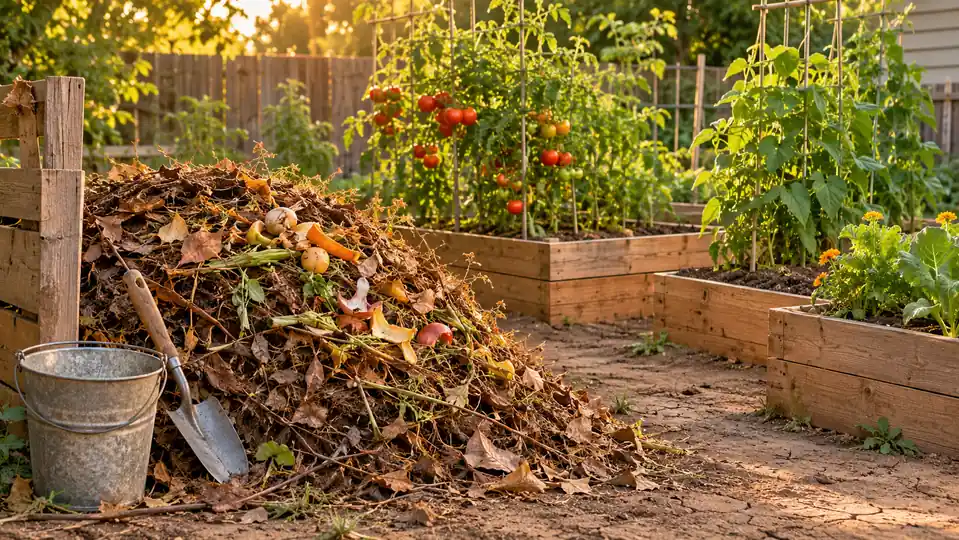
The bin is the delivery system. The pile behind the raised beds does the work. My soil is Front Range clay, heavy and alkaline, and it has taken me five years of hauling compost to get three beds that grow a tomato worth eating. The bin has roughly doubled how much kitchen waste gets out there, because the old pail filled up and got dumped in the trash about a third of the time without anyone admitting it. Nora noticed. Nora always notices.
What the garden got out of it was not dramatic and it was not fast. The pile was bigger last fall than the fall before, the beds got a heavier top dressing in October, and the green beans did better this year than they have in three. That is not proof of anything. It is one season in one yard with hail in June, and I am not going to pretend a countertop bin changed my soil chemistry. What it changed was whether the scraps made it out the back door at all, and that part is measurable.
What I Liked
- Airtight lid genuinely keeps odors in, even in July and August
- Replaceable activated charcoal filter, three to six months per filter
- 1.3 gallons fills in about three days, so scraps never sit long enough to turn
- Stainless steel inside and out, no rust or peeling after a full season outdoors and in
- Small footprint at 7.16 inches across and 11 inches tall, so it stays on the counter where you use it
Where It Falls Short
- No liner, so the bin itself needs a scrub about once a month
- Charcoal filters are an ongoing cost, three or four a year in my kitchen
- 1.3 gallons is small for canning days or large families
- Stainless shows fingerprints around the lid and wants a weekly wipe
- None of the sealing matters if you leave scraps in it for a week in August
The bin does not make compost. It makes sure the scraps reach the pile instead of the trash can, which was the part I kept failing at for two years.
Who This Is For
This is for someone who already has a pile, a backyard bin, or a curbside program, and whose kitchen scraps currently go in the trash because the container is a nuisance. One or two people cooking most nights, about seven inches of spare counter, and a household that will actually carry the thing out twice a week. It suits a small garden and a short season, which is exactly what I have in Loveland. It also suits anyone who tried a plastic pail, got tired of the smell and quit, because the seal and the filter are what make the difference between a bin you keep using and one you exile to the garage sometime in June.
Who Should Skip It
Skip it if you cook for five or do a lot of canning. You will fill 1.3 gallons before dinner is on the table and you will resent the trips. Skip it if you have nowhere to put the scraps, because a countertop bin is a holding container and not a composter, and a sealed bin of scraps left for a week in August is worse than scraps in the trash. Skip it if you want something you never have to wash or think about, because this wants a monthly scrub and a filter change. And skip it if buying charcoal a few times a year bothers you, because that is the arrangement. I would rather you knew it now than in August.
If your scraps are still going in the trash, this is the fix that stuck for me
A full season on my counter, twice-weekly trips out to the pile, one small filter to change every few months. That is the whole arrangement, and it has held.
Amazon Check Today's Price on Amazon →