
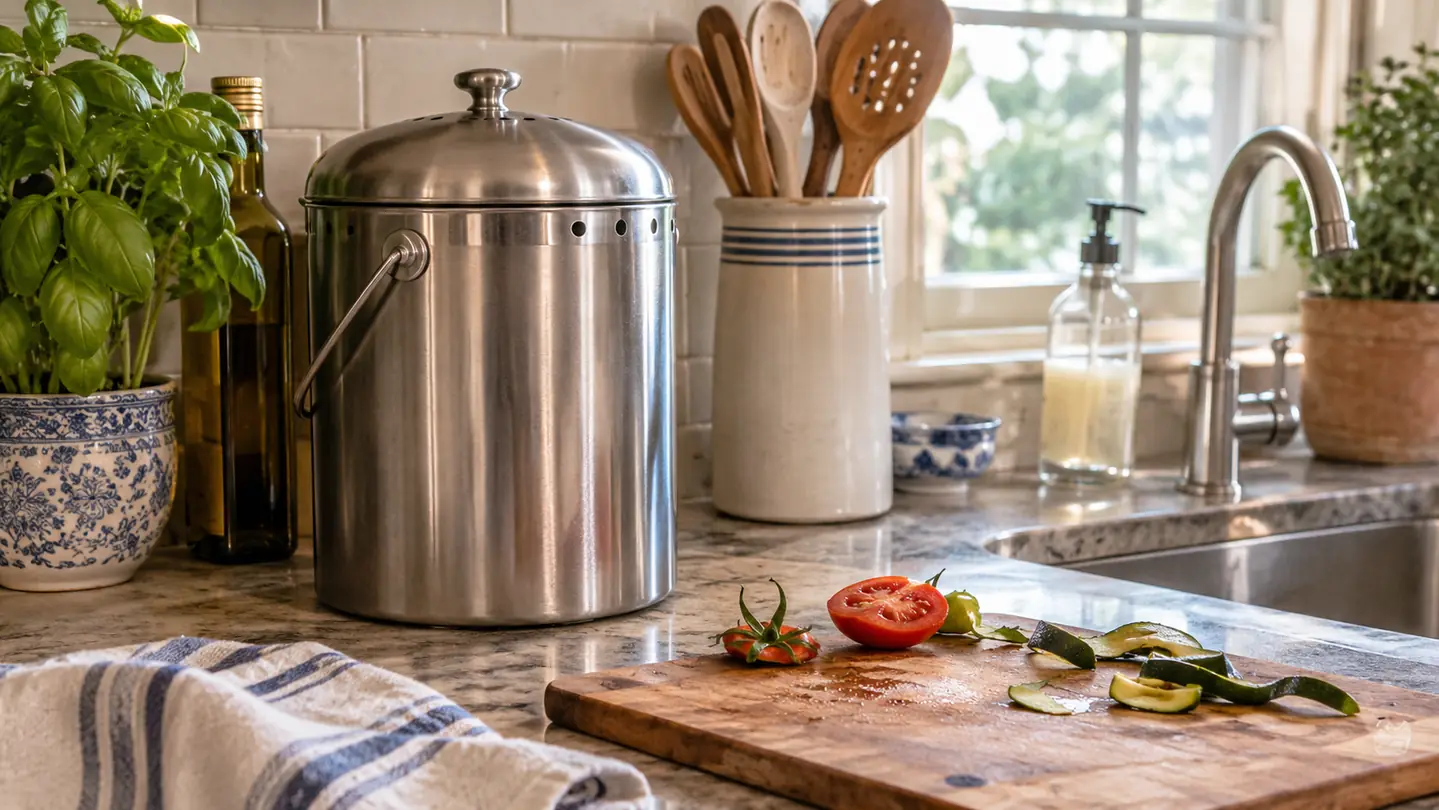
The first time my granddaughter Nora counted the zip-top bags in my kitchen drawer, she got to forty-one and stopped counting out loud. She was fifteen and full of the moral certainty of a person who has never paid a water bill. But she was right about the drawer. What she did not expect, and neither did I, was that the change I stuck with longest had nothing to do with bags. It was a small bucket that sits on the counter to the left of my sink. I bought the Epica countertop compost bin last March, before planting, and it has not moved since.
I garden in three raised beds behind the house and a cluster of pots on the patio. Tomatoes, zucchini, green beans, herbs. Clay soil, dry air, and a season short enough that you blink and the hail has taken your peppers. Five years in and I still lose a plant or two every summer. What I did not have until last spring was any real supply of finished compost. I had a pile behind the beds that I fed about once a week and ignored the rest of the time. The bin is what made that pile worth walking to.
The bucket that turned my scrap pile into something worth walking to
1.3 gallons, an airtight lid, and a replaceable charcoal filter. It has sat left of my sink since last March and my tomatoes got the first finished compost I have ever made.
Amazon Check Today's Price on Amazon →It cuts the trip to the pile from every evening to twice a week
Before the bin, I kept a plastic tub by the sink and carried it out every single night, because by night two it smelled. The Epica holds 1.3 gallons, which for one person cooking most evenings is roughly three days of peels, coffee grounds, and the ends of things. I carry it out Tuesday and Friday. That sounds like a small thing to put on a list. It is not small at eight in the evening when my knees are sore and the last thing I want is a walk around the side of the house.
The charcoal filter is the reason it does not smell like a garbage can
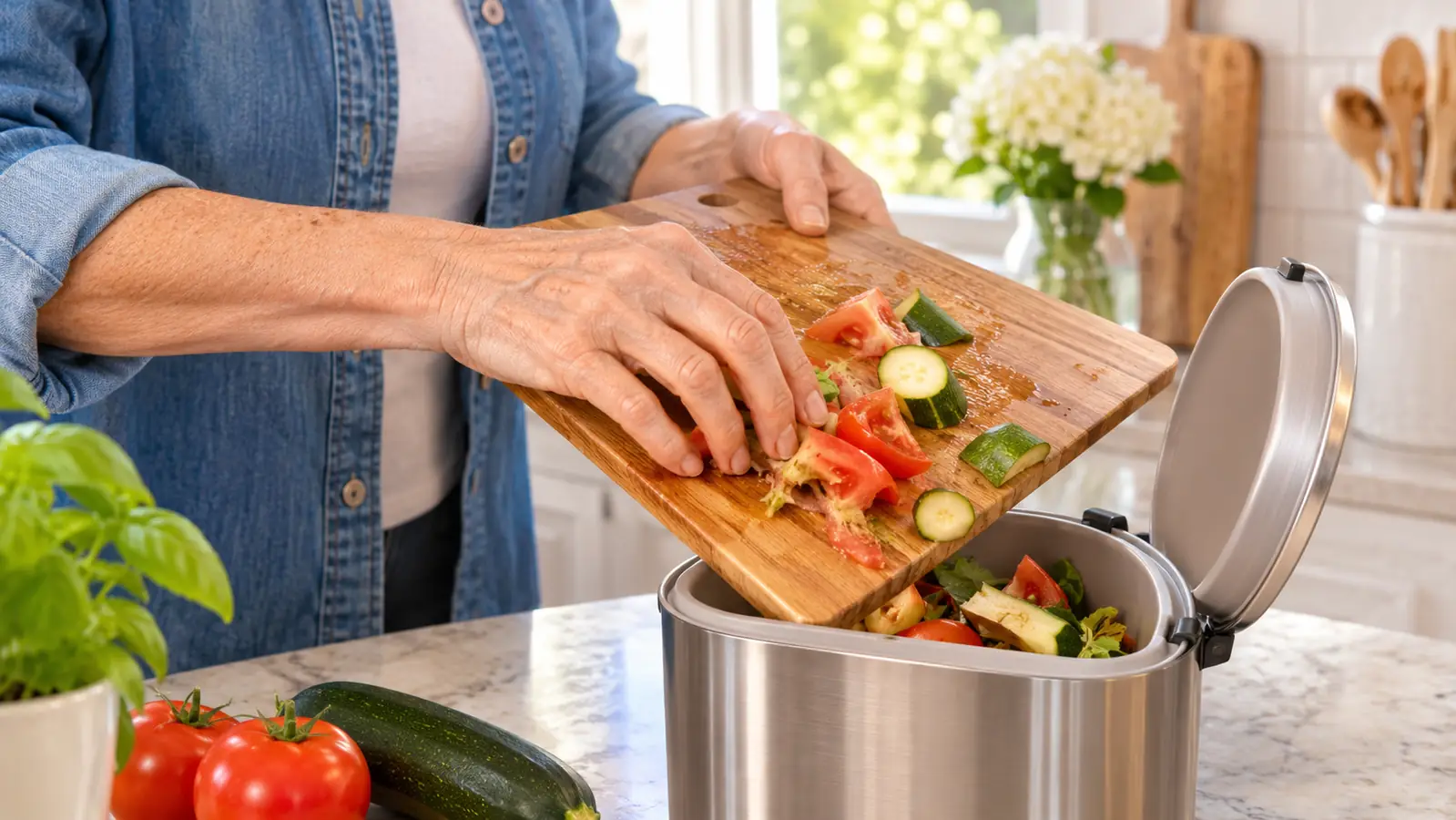
An airtight lid does half the job. The filter does the rest. The Epica has a replaceable activated charcoal filter, and the company says each one lasts three to six months. Mine runs closer to three in July and August, when the bin is full of tomato cores and the kitchen is warm. You can rinse the filter and let it air dry to get more life out of it, but do not soak it. I keep a spare in the drawer with the twist ties.
The lid seals, so the fruit flies stay outside where they belong
Fruit flies in late August used to be a fact of life in this kitchen. Bowl of tomatoes on the counter, flies by evening. The airtight lid is the difference between a sealed bucket and an open invitation. I still get flies when I leave a cut tomato out on the board overnight, but I no longer get them from the scrap bucket, which was the steady supply. If you have ever swatted at the air while you chop, you know what a sealed lid is worth.
It fits in the dead space beside the sink
It measures 7.16 inches across and 11 inches high, cylindrical, so it takes up less counter than my dish rack. Mine sits between the sink and the coffee maker, a spot where nothing else ever fit. If your counter is as short as mine, measure before you buy anything bigger. A gallon and a third sounds small, and it is, which is exactly why it does not need its own zip code.
Stainless steel does not hold onto the smell of last week
The body is stainless steel, not plastic. Plastic tubs scratch, and once they scratch they keep a smell that no amount of washing gets out. I had one of those for years and I could smell it from the doorway. Stainless does not stain from tomato and does not absorb anything. After a season of near-daily use, mine still looks like something I would leave on the counter with company coming, which is more than I can say for the tub it replaced.
It swallows an afternoon of putting up tomatoes
The last week of August I stood at that counter for three hours with a paring knife and a pile of tomatoes, and the bin took every core and every split one without filling up. When it did fill, it was one walk out to the pile, one rinse, and back to work. If you freeze or can what you grow, this is the stretch of the season where a small bin beside the cutting board earns its place.
It gave Caleb a job he actually asks for
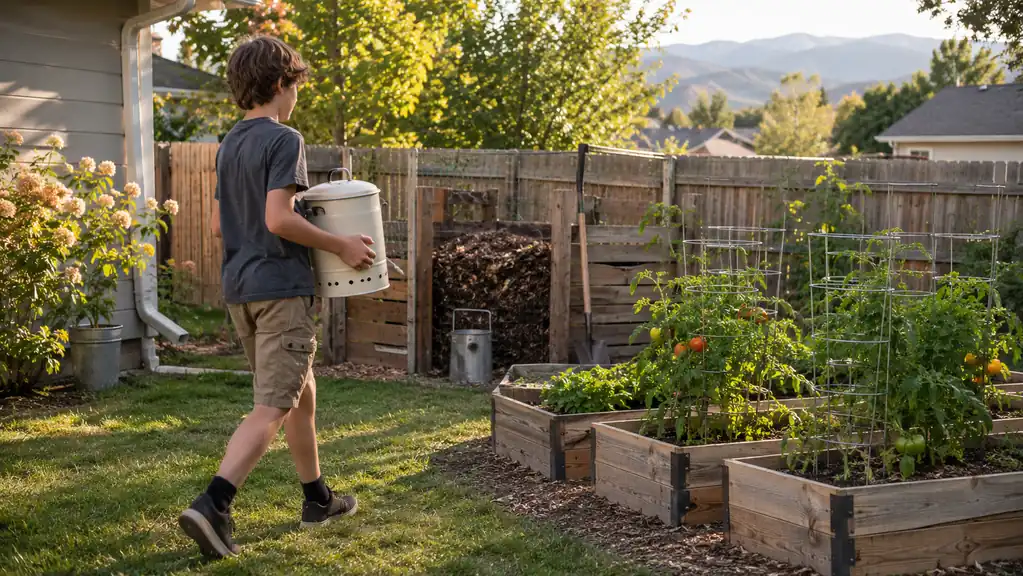
My grandson Caleb is twelve. He plays baseball, he eats like the season depends on it, and he has decided that carrying the bin out is his job. I am not going to examine the reasons too closely. He takes it around the side of the house, dumps it on the pile behind the raised beds, and comes back for a cookie. Whatever he likes about it, I get a break and the pile gets turned more often than it ever did when I was doing it alone.
The pile actually gets walked to, which is the whole point
For four years I had a compost pile behind the beds that I fed about once a week and turned about once a summer. A pile you visit every few days is a different object. You notice when it is too dry, which out here it always is. You notice when it is not heating, and you turn it. Mine was finished enough to screen and put on the tomato beds this spring, which had not happened once in the five years before.
It makes the waste visible, and that changes what you buy
This is the part Nora would like. Scraps in an open bowl on the counter stop registering. Scraps in a bin you carry out and rinse twice a week start to register. You notice how much of a head of lettuce you throw away, how many zucchini you let go soft because you planted too many. I buy less than I did. Not because I turned into a different person, but because the evidence sits next to the sink twice a week.
The upkeep is one rinse and a filter a few times a year
There is no manual to read. You rinse the bin, you let the filter air dry when it starts to smell, and you put a new one in every few months. That is the whole routine. I have had gadgets in this kitchen that needed more attention than my houseplants and ended up in a box in the basement. This one is a bucket with a good lid, and I mean that as a compliment.
What I'd Skip
If you cook for four or five people, the 1.3 gallon size will have you emptying it every other day, and I would look at something larger or buy two. If your whole garden is three pots on a balcony, you do not have a pile to feed, and a filtered bin is a fussy way to hold scraps until trash day. I would also skip lining it with a plastic bag. I did that for the first month out of pure reflex and all it did was add back the plastic I was trying to cut. And if you are hoping for something that composts on your counter by itself, this is not that. It is a bucket. A well-sealed, well-filtered bucket, but a bucket. The composting happens out back, in the pile, in the weather, on its own schedule.
The bin does not compost a thing. It just makes the walk to the pile short enough that I actually take it.
Start with the bin. The pile follows.
Mine has held a season of tomato cores and coffee grounds and still looks like something I would leave out for guests. Epica says each filter lasts three to six months, so order a spare while you are there.
Amazon Check Today's Price on Amazon →