
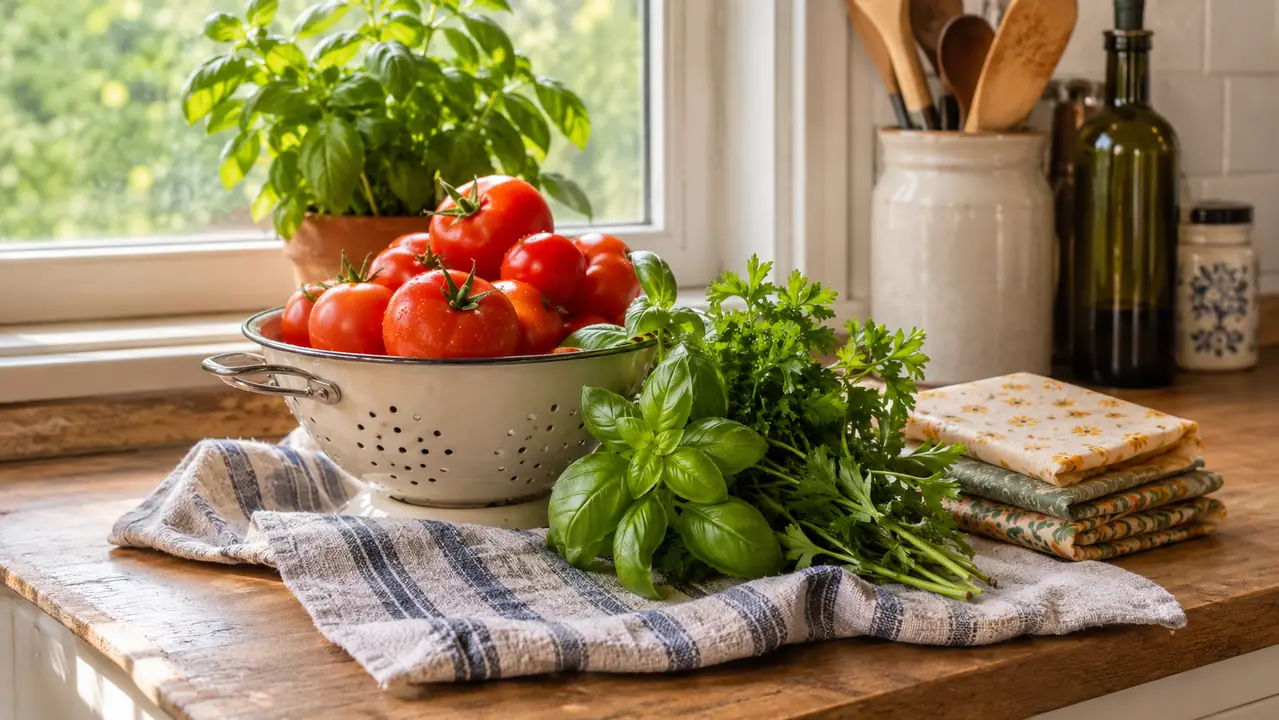
By the second week of August my kitchen counter stops being a counter. Three raised beds in a Loveland backyard do not sound like much until every tomato in them decides to ripen in the same seventy-two hours. Then I am carrying colanders into the house and setting them down wherever there is a square inch of space that is not already holding a zucchini.
For years I handled that glut the way my mother handled it, with a roll of plastic wrap and a certain amount of muttering. The wrap clings to itself instead of the tomato. The cut face goes soft by morning. The herbs turn to slime in a sealed bag. Last summer my granddaughter Nora, who is fifteen and has appointed herself the recycling police of this family, asked me how much of that roll ended up in the trash by September. I did not have an answer I liked. So I bought a three pack of Bee's Wrap, worked out this routine on the harvest, and it is the routine I am still using a year later.
Three sizes of cloth that replaced the roll in my kitchen drawer
I bought the three pack myself after Nora asked her question, and I have not bought plastic wrap since. Small, medium and large, cotton with beeswax, hand washed and composted when they finally wear through.
Amazon Check Today's Price on Amazon →What the Wrap Actually Does
It is worth being plain about this, because I think people expect more from the thing than it can give. Bee's Wrap is cotton with beeswax, organic plant oils and tree resin worked into it. It is not a lid and it is not a vacuum seal. What it does is sit against the food and slow the air down, and because it breathes a little instead of sealing everything off, the texture of what is underneath holds up better than it does under plastic.
That breathing is the part I did not expect to matter. A sealed bag traps every bit of moisture the food gives off, and herbs in particular drown in their own damp. The wrap lets some of that out. I noticed it first with basil, which used to blacken within two days in a zip-top bag and now goes four or five in the wrap before it starts to fade.
What it will not do is rescue bad produce. A tomato that is already splitting from too much rain is going to go, wrap or no wrap. The wrap buys time on food that was sound when it went in. That is the whole of the promise, and for a garden in August it is enough.
Step 1: Pick at the right moment and dry everything before it touches the wrap
A tomato should come off the vine fully coloured, with just a little give at the shoulder, not hard and not collapsing. I pick in the morning after the dew has burned off. If it rained overnight I wait, because a wet tomato is a tomato that will spoil early no matter what you wrap it in.
The other half of this step is the one people skip. Everything goes onto a dry kitchen towel before it goes near a wrap. I line a basket with a dish towel, set the tomatoes in a single layer, and leave them on the counter for an hour while I do something else. Any water on the skin, any damp at the stem end, and the wrap will not sit right and the food beneath it will go soft faster. A dry surface is what the wax grips. I learned that the summer before I bought the wraps, when I rinsed four Early Girls and wrapped them still beaded with water, and found them furred by the next afternoon. Four tomatoes and one lesson I have not needed twice. Now the towel comes out before the colander does, and I do not rinse a tomato I mean to keep.
Whole tomatoes that are going to be eaten within a few days do not get wrapped at all. They sit on the counter, out of direct sun, stem side down. The refrigerator turns them mealy and I would rather eat them on Tuesday than keep them until Friday.
Step 2: Wrap the cut half, and leave the whole ones alone
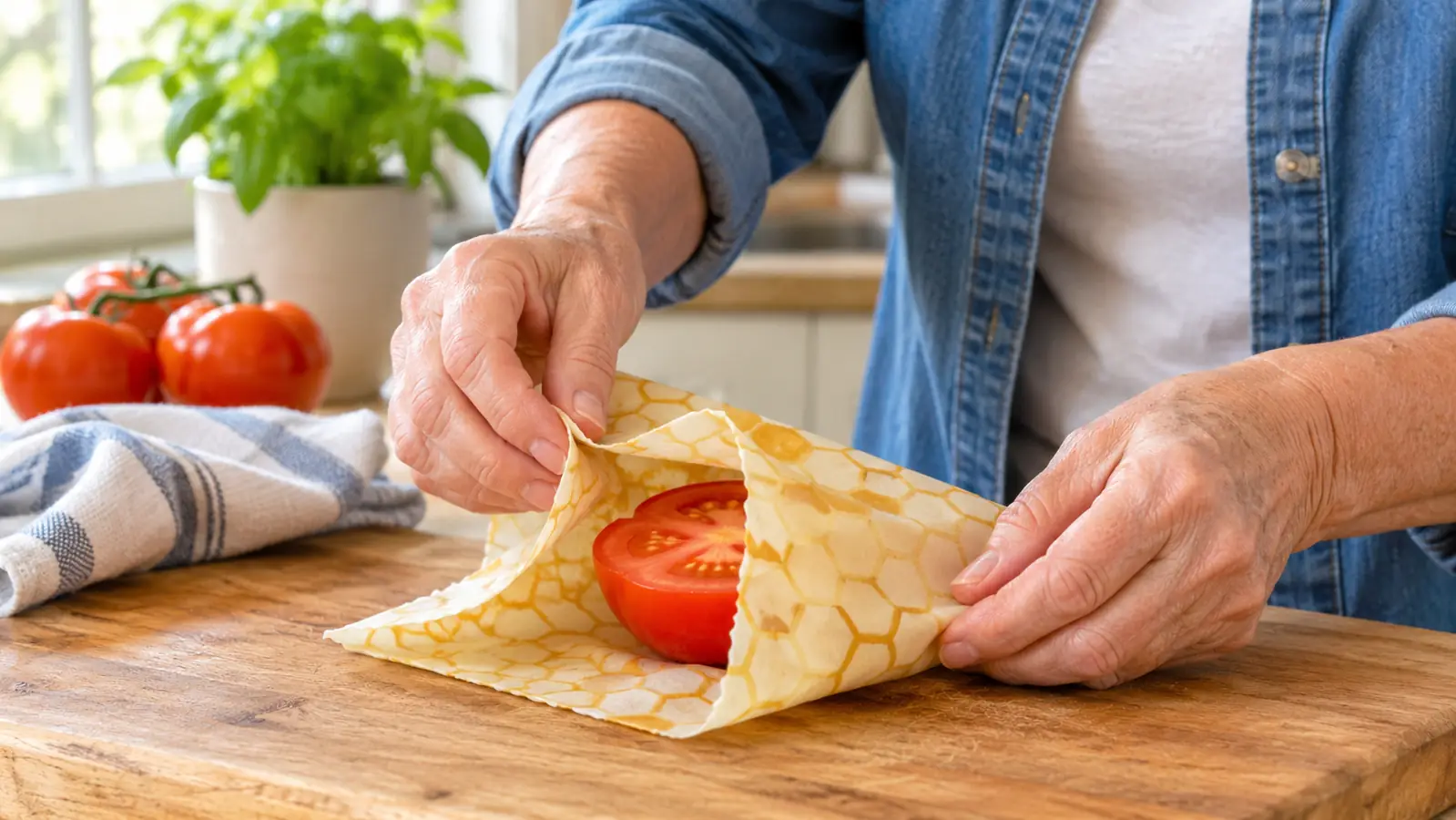
This is where the three pack earns its place. The small wrap handles half of a smaller tomato or the end of a cucumber. The medium is the one I reach for most, and it takes a big slicing tomato with room to fold. The large is for a bunch of herbs or a piece of bread.
Cut side goes down on the cloth, then you fold the corners in over the top like you are tucking something in. I press the whole thing against my palm for a few seconds. The wax softens from the warmth of a hand and the folds hold themselves, which is a thing I did not believe until I tried it.
What I do not do is wrap raw meat in these. That is my own house rule and not something printed on the package, but I keep one wrap for produce and one for cheese and I do not cross them over. Cheese gets its own piece, and it has lasted noticeably longer than it did in the plastic it came home in.
Step 3: Treat cut herbs like a bouquet before you wrap them
Herbs are where the difference was largest for me. Basil, parsley, cilantro, whatever the bed is giving that week. I cut in the morning, rinse, and then dry them properly, which means a towel and a few minutes of patience, or a salad spinner if you have one and the counter space.
Then I bundle them like a small bouquet, stems together at the bottom, and wrap around the leaves, leaving the stem ends a little open at the base. That open end matters. The wrap breathes, and leaving the stems exposed gives the moisture somewhere to go instead of pooling against the leaves.
Big bunches go in the large. A handful of parsley for one dinner goes in the small. Anything I am going to use within a day or two just stands in a glass of water on the counter with no wrap at all, and that is honestly better than any wrap for soft herbs you are about to eat. Cilantro is the one that taught me the most. It bolts the minute the heat settles in, so I cut the whole plant in one go and stand the stems in an inch of water in a jam jar until I have time to deal with them. Wrapped that evening, a bunch held from a Thursday to the following Tuesday, which for cilantro in a Colorado August is a long while.
Step 4: Let the warmth of your hands do the sealing
There is no clip, no band, no elastic. You press. The wax in the cloth softens at body temperature and takes the shape you give it, so a few seconds of holding is the difference between a wrap that stays put and one that springs open in the drawer.
I press the seam with my thumb until I feel it grab, then set the bundle seam side down on the shelf so its own weight helps. Bowls get covered by pressing the cloth down over the rim and smoothing it against the sides. This is not a tight seal, and a bowl of soup is going to leak if you tip it. For a bowl of leftover beans or half an onion it is fine.
One more note on the warm hand trick. It works better on a cool day than a hot one. In the middle of a Colorado July the wax is already soft and the wrap will feel tacky straight out of the drawer. It still works, it just takes less pressing than you think.
Step 5: Wash it cool, air dry it, and never fold it away wet
Cool water, a drop of dish soap if it needs it, hands rather than a scrubber. I have found that hot water softens the wax more than I want and the cloth starts to feel tacky and smells faintly of whatever was last in it. Cool water and a quick rinse keeps it fresh and keeps the surface working.
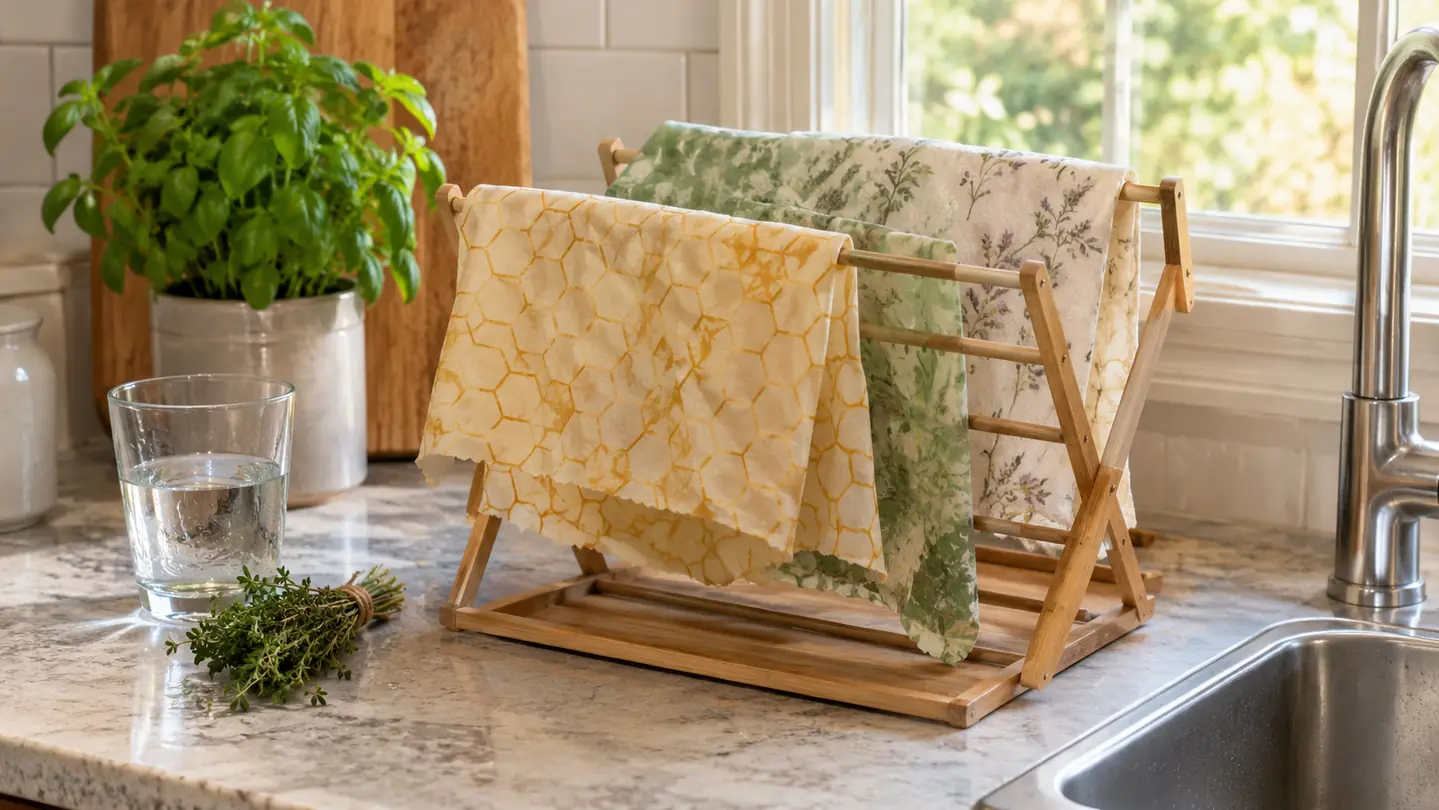
Then it goes on the dish rack and stays there until it is properly dry. This is the step I got wrong at first. I folded a damp wrap back into the drawer in July and came back to a cloth that smelled like a wet basement. Air drying takes an hour, less if there is a breeze through the kitchen window. The other mistake was scrubbing. One wrap had picked up a smear of tomato juice along a corner, and I went at it with the rough side of a sponge and hot water, and that corner never held a fold the same way again. Cool water and your fingers from the start, that is what I would tell anyone.
The Bee's Wrap cloth does eventually wear out. When one stops holding and the surface looks worn rather than waxy, it goes into the compost, which is the reason I am willing to use them at all. Nothing about this leaves a bag in the trash for the next few hundred years, and Nora checks.
What Else Helps
The wrap is one piece of a system, and the system matters more than any single item in it. The tomatoes that are perfectly ripe go on a plate on the counter where I will see them and eat them first, not into the refrigerator where I will forget them. The ones I cannot get to get halved and wrapped. The ones that are already going go into the compost bin on the counter, which I empty into the pile behind the raised beds about twice a week and which Caleb, my twelve year old, carries out for me when he visits because he likes the job.
The extra green beans go into the freezer in a silicone bag, not a wrap. I blanch them first, a minute and a half in boiling water and then straight into a bowl of ice water, and then I dry them on a towel the way I dry the tomatoes. That is the difference between beans that taste like beans in February and beans that taste like the inside of the freezer. Wraps are for the counter and the top shelf of the fridge, not for the long haul. If I have more zucchini than any reasonable person can eat, I leave it on a neighbor's porch, which is a storage method I recommend highly and which costs nothing at all.
And it helps to be honest about the limits. These are not going to keep a head of lettuce crisp for two weeks. They are not a lid for a travel container. They are not much use over a nine by thirteen pan unless you have two of them and some patience. What Bee's Wrap is good at is the small daily business of a garden, half a tomato, a bunch of parsley, a hunk of bread, and it is good at that without adding anything to the trash.
Same tomato, same Thursday, and the only difference between the two halves was what I wrapped them in.
My daughter thinks the whole experiment is funny, given how long I resisted it. But she took two wraps home to Fort Collins in June, and she has already asked me where I got them, so I know how that story ends.
The drawer where the plastic wrap used to live
Three sizes, cotton and beeswax, washed by hand and composted at the end of their life. Mine have been in weekly use on the garden harvest since last summer and I have not bought a roll since.
Amazon Check Today's Price on Amazon →