
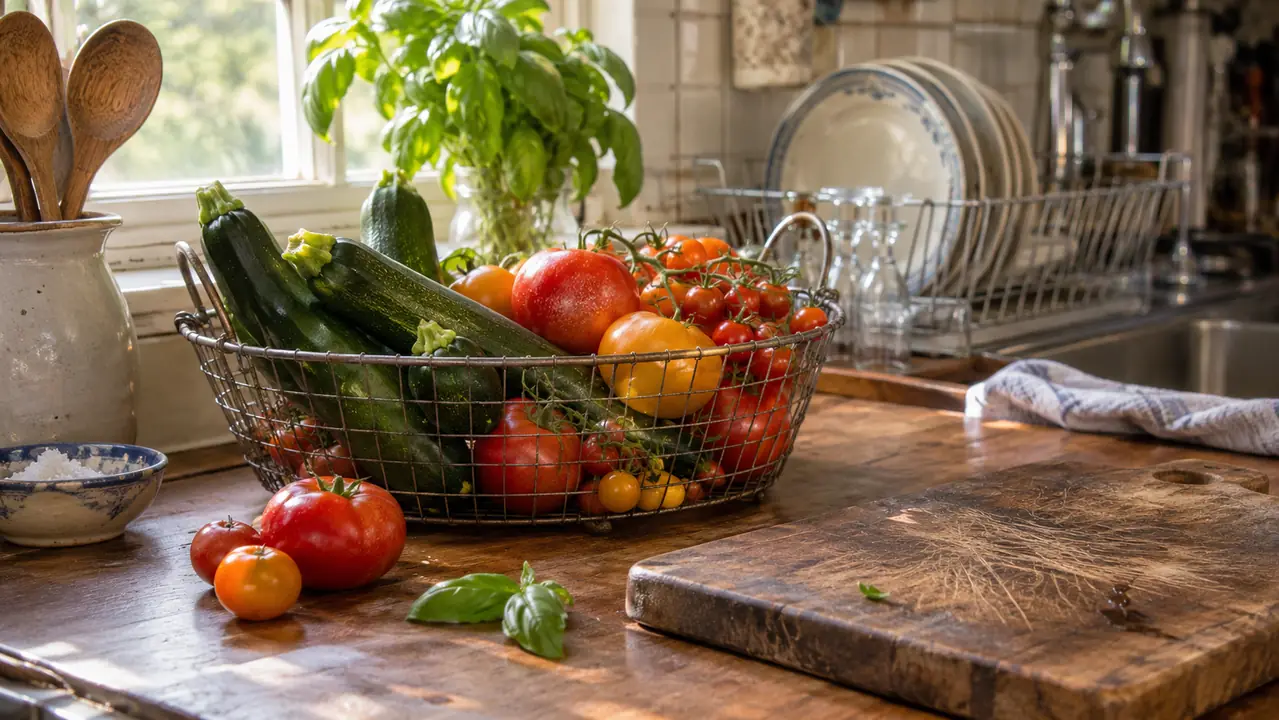
By the first week of August, my kitchen counter had stopped being a counter and become a zucchini parking lot. Three raised beds in a Loveland backyard will do that to you. The tomatoes were not far behind, and the green beans came in like a rumor that turned out to be true. I bought a three pack of Bee's Wrap last summer for one plain reason. I was tired of digging a new box of plastic wrap out of the drawer every ten days, and tired of Nora, my fifteen-year-old granddaughter, counting the zip-top bags in my kitchen like a bank auditor. She is the recycling police of this family. She is the reason I started any of this at all.
That was a year ago. Since then the wraps have been through a whole gardening season, a winter of cheese and bread, a spring of herb bundles, and one long summer of squash. Most of it went well. A couple of things did not. What follows is what ordinary use actually looked like in my house, not a laboratory test and not a pep talk. If you want the short version, it is below. If you want the version with the zucchini in it, keep reading.
The Quick Verdict
A genuinely useful three pack that walked through a Colorado garden summer without fuss. It will not empty every plastic bag out of your drawer, and it asks for a minute of hand washing to keep going, but mine are a year old and still earning their keep.
Amazon Check Today's Price →If your counter is drowning in August produce, start with the three pack
Small, medium and large covers a half-cut zucchini, a block of cheddar and a loaf of bread. Mine have been in weekly rotation for a year and none of them have quit.
Amazon Check Today's Price on Amazon →How I've Used It
All three sizes live folded flat in the drawer next to the silverware, and I reach for them without thinking now. The small one takes the odd jobs: the tail end of a cucumber, half a lemon, a knob of ginger, the last of a block of parmesan. The medium is the workhorse. It covers cheese, a cut tomato, a bowl of leftover rice, and sandwiches for Caleb when baseball season runs long and that boy eats like the field is on fire. The large one handles a loaf of bread, a head of lettuce, or a bunch of cilantro from the patio pots. Three sizes sounded like marketing to me at first. A year in, I use every one of them every week. The second Saturday in August I counted, because I am a retired librarian and counting is what I do. Between seven in the morning and nine at night, the Bee's Wrap set covered half a zucchini, a block of cheddar, a cut tomato, a bowl of green beans, and one loaf of bread. Five trips into the drawer, three wraps, one wash at the end of the day. That is an ordinary Saturday in August and it has not changed much since.
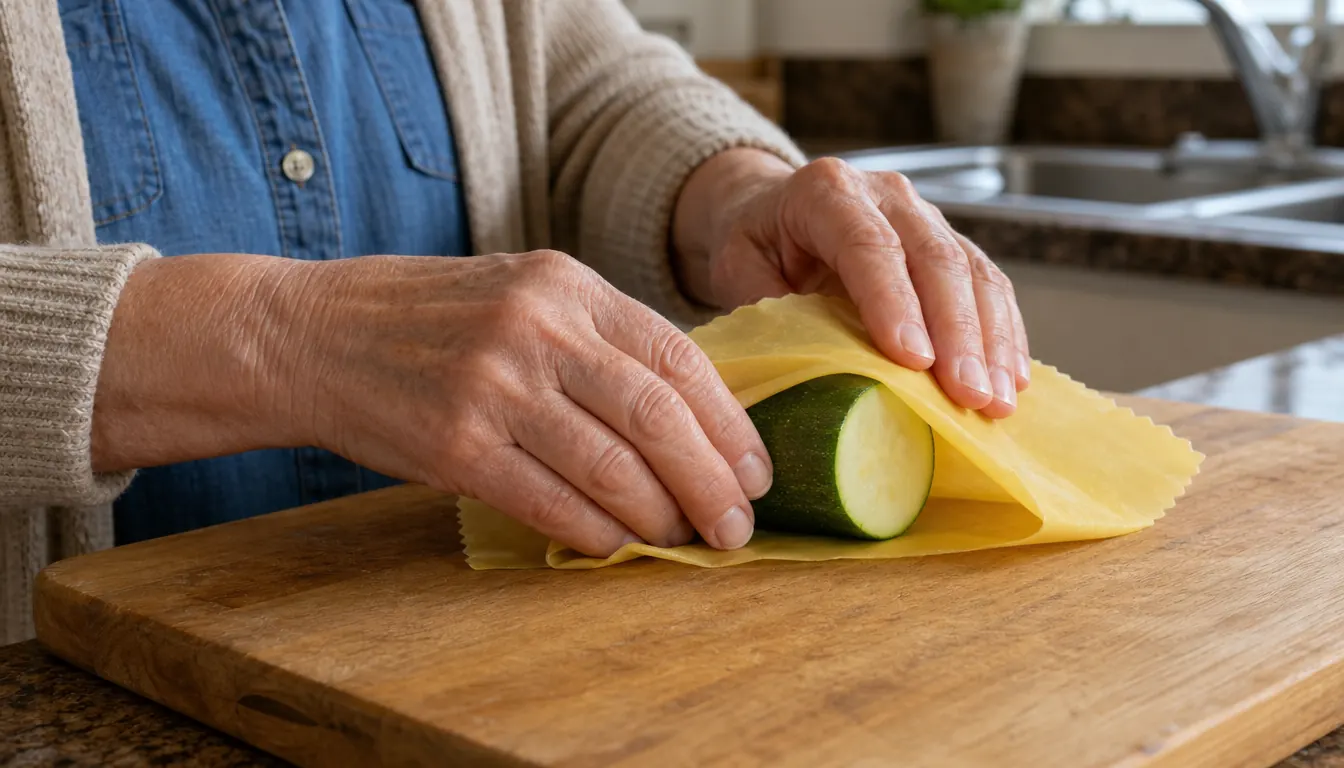
The technique is smaller than you would expect. You warm the wrap between your palms for a few seconds until it goes soft and a little tacky, then you press it around whatever you are covering and it holds itself in place. That is the whole thing. No clips, no rubber bands, no fiddling. My hands are sixty-eight years old and stiff in the mornings, and they manage fine. The first week I overthought it badly and tried to fold the corners like a present for a baby shower. It does not need that. Just press.
The material is cotton coated in beeswax, organic plant oils and natural tree resin, and that is the entire list. Bee's Wrap prints that list on the package and there is nothing else hiding in it. Nothing inside my refrigerator smells like a candle, which was a worry I had and did not say out loud to anyone. The set I bought carries the bees and bears print. Caleb spotted it on the first day and now points it out on every visit, as though I might have forgotten since Tuesday.
What Comes in the Three Pack
You get one small, one medium and one large, which lines up with the three jobs that actually come up in a kitchen: a scrap, a block, a loaf. The wraps are cotton, so they have a little give and a fabric hand to them rather than the stiff snap of plastic film. They are breathable, and that is the detail I did not appreciate until I had used them for a month. Plastic film seals everything in, including the moisture that turns a head of lettuce to slime. A beeswax wrap lets some air move. My cilantro and my green beans lasted noticeably longer than they ever did under film, and I am not a person who usually notices that sort of thing.
The print is charming in a way that surprised me, since I am not much for decoration on my kitchen tools. It has held up through a year of washing without fading into a gray smear, which is more than I can say for the dish towels. A year of washing has not thinned the coating or frayed an edge on any of the three either, and the print is still clear. If you would rather have something plainer, that is a taste question and not a performance one. What matters is the coating, and the coating has stayed put on all three of mine.
A Full Season on the Counter
Here is where the wraps earned their place. A zucchini comes out of the garden at eleven in the morning and I only need half of it for the evening meal. The other half goes cut side down on a wrap, gets pressed closed, and sits in the refrigerator until Thursday. No rubber band, no plate balanced on top of it, no dried out pale disc to throw away. The same goes for tomatoes, which is the real test in my house. A cut tomato under film goes soft at the edges within a day. Wrapped in beeswax it holds its texture long enough that I stop feeling guilty about cutting one open.
Bread was the surprise. I bake two loaves a week in the cool months and I used to keep them in a plastic bag that got sweatier every day. The large wrap keeps a crust a crust. The first loaf I tried it on was a Saturday oatmeal bread, still warm when I wrapped it, which I later learned was a mistake, since the warmth softens the coating for a few minutes and the wrap wants to sag. I let the second loaf cool on the rack for an hour first and it went on clean. Cheese has been the same story, cheddar and a hard jack mostly, no sweating, no dried rind, and a block that sat in the medium wrap from a Tuesday to a Sunday still sliced clean at the end of it. And through the summer I wrapped sandwiches for Caleb in the medium, tucked it in his lunch sack, and had it come home looking none the worse after a day in a hot dugout.
The green beans were the other test. I froze most of the surplus in the silicone bags Nora talked me into, but the ones headed for the refrigerator within a day or two went into a wrap. They stayed crisp. Not crisp forever, mind you. Nothing in my kitchen stays crisp forever. But longer than the bags ever managed, and with no paper towel inside doing the work.
The Washing Part Nobody Warns You About
This is the part that decides whether you keep using them. You wash these by hand in cool water with a little dish soap, and you do not put them in the dishwasher. Hot water melts the coating and you will know it the moment you touch the wrap and it feels like a dishrag instead of a wrap. I learned that the hard way in September, when I ran the water hot out of habit while rinsing a plate and then picked up the small wrap without thinking. It went limp and slick and took two days of sitting flat on the rack in a cool kitchen to come back to itself. It did come back, which surprised me, but I have not made that mistake twice. Bee's Wrap asks for cool water and a soft cloth on the package and they are not being fussy about it. Mine air dry flat on the dish rack next to the sink. It takes about a minute, once a day, for all three. I have timed it. A minute.
That minute is the whole cost of owning these, and it is the reason some people will give up on them in week two. If you are the sort who needs to throw everything in the machine and forget it, this is not your product and no amount of good intentions will change that. I will also say plainly that I do not use these on raw meat or on anything that has touched raw meat. That is my own rule, not a claim on the package, and the wraps have never given me a reason to doubt it. Onions and garlic I keep in a jar. Strong smells have a way of settling into the coating.

Where They Fell Short
They do not seal like a zip-top bag, and they never will. If you are covering a bowl of soup or a cut melon that weeps, the wrap will hold the shape but not the liquid, and you will end up with a puddle. I tried a half cantaloupe in the large one in June and came back to a sticky ring on the shelf and a wrap that needed a proper wash before it would press shut again. I still keep plastic for the freezer and for anything going in a marinade. My honest score on this is that the wraps replaced maybe three quarters of the film I used to buy, not all of it. Three quarters is not nothing. It is a trip to the store I no longer make.
In a hot kitchen in July the coating gets tacky and the wraps want to stick to each other in the drawer. I solved it by keeping them folded with a scrap of parchment between two of them, which sounds fussy and is not, but it is one extra thing to do. There was one afternoon in mid July when the kitchen reached ninety and the medium wrap clung to the small one so stubbornly that I peeled them apart too fast and creased a corner. The crease never fully flattened out. It still works. It just looks like a wrap that has been used for a year, which it has. The other thing I will not pretend away is the cost. These run higher up front than a box of film, and if you do not make a habit of using them the arithmetic does not work out. I do not know how many years mine will last. A year in, all three are still pliable and still pressing shut, and I will report back when that changes.
What I Liked
- Handled a full garden season of cut zucchini, tomatoes and green beans without letting them go soft at the edges
- Breathable cotton coating kept herbs and bread in better shape than plastic film ever did
- Three sizes that map to the jobs that actually come up: a scrap, a block, a loaf
- Molds to shape with a few seconds of hand heat, no clips or bands needed
- A year of weekly use and all three are still pliable and still pressing shut
Where It Falls Short
- Hand wash only, in cool water, and the dishwasher will ruin the coating
- Does not hold liquid, so bowls of soup and weeping fruit are out
- Coating goes tacky in a hot July kitchen and the wraps stick together in the drawer
- Costs more up front than a box of plastic film, and only pays off if you actually use them
A cut tomato under film goes soft at the edges within a day. Wrapped in beeswax it holds long enough that I stop feeling guilty about cutting one open.
Who This Is For
This is for the person whose refrigerator is full of half things. Half a zucchini, half an onion, half a lemon, half a loaf. If you garden, or if you shop once a week and cook from what you brought home, you already have the problem these solve. It is also for anyone trying to cut down on the drawer full of plastic, which is where I started, with a granddaughter doing the counting. Nora has approved, for the record. She inspected the whole Bee's Wrap set on the back patio and gave me a nod, which from a fifteen-year-old is high praise.
Who Should Skip It
Skip these if you know in your heart that you will not hand wash them. A wrap that goes through the dishwasher is a rag, and a rag in the drawer is worse than the film you were already buying. Skip them if you mostly freeze, or mostly store liquids, or mostly cover things in a hurry with one hand while the other hand holds a phone. Skip them if the up front cost will nag at you, because the nagging will outlast the wraps. And skip them if you want a product that does everything. This one does most things well and a few things not at all.
Three sizes, one drawer, and no more dried out tomato halves
If you have read this far and recognized your own refrigerator in it, the three pack is the place to start. Mine have been through a garden season and a Colorado winter and they are still in rotation.
Amazon Check Today's Price on Amazon →