
Last winter my granddaughter Nora stood at my kitchen counter holding an empty paper towel roll like it was evidence in a case she was building. She is fifteen, she is the self-appointed recycling police in this family, and she had spent a week counting how many sheets I pulled off that roll. The number embarrassed me. So I did what any retired librarian would do: I wrote it on an index card and taped it inside a cabinet door where only I would see it.
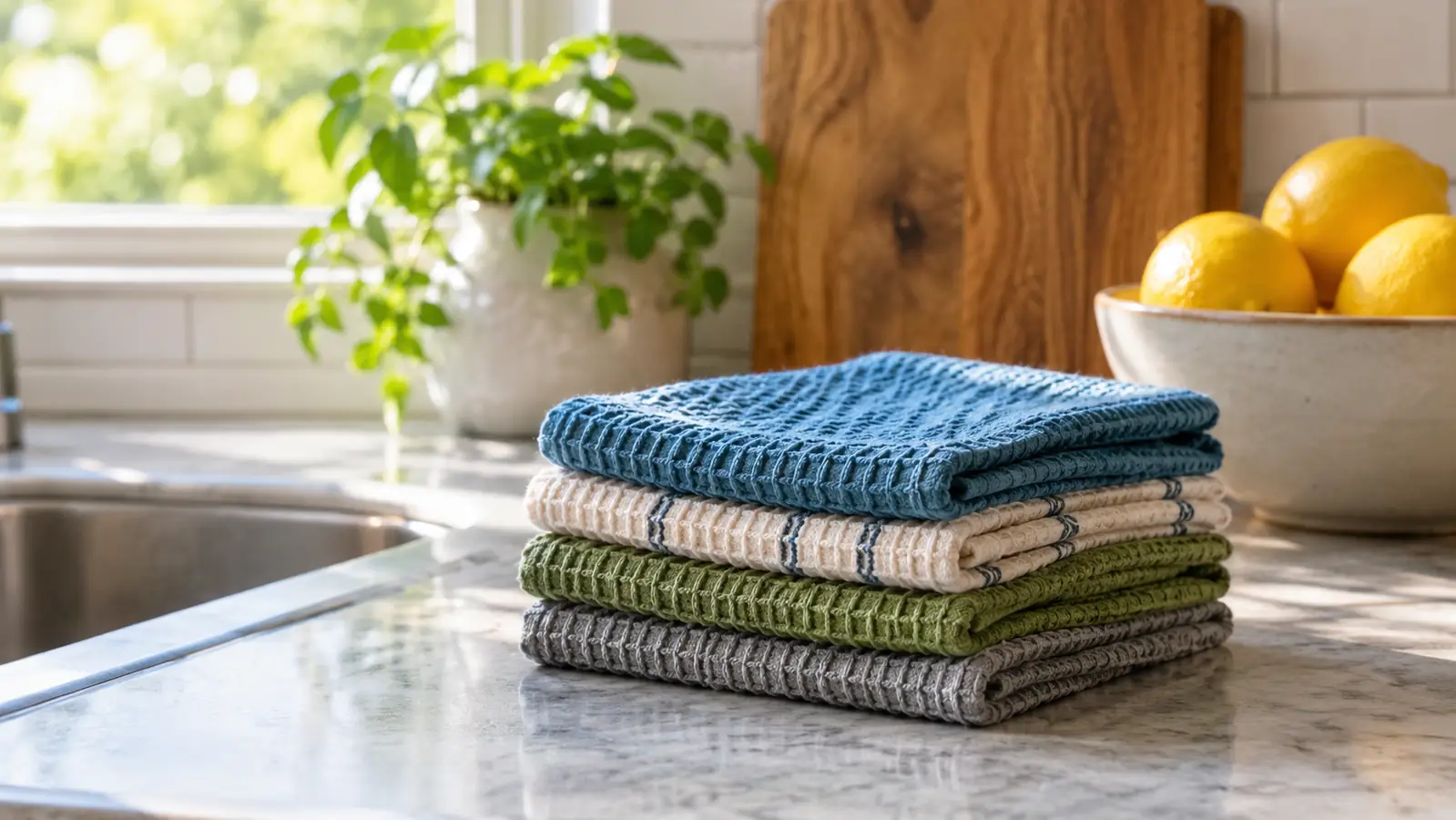
Before that card went up, I had already tried the usual substitutions. Cut-up t-shirts, which smeared a spill instead of absorbing it. Cellulose sponges, which went sour in about four days and smelled like the bottom of a bucket. A pack of microfiber cloths that pushed water around the counter and then held onto grease no matter how I washed them. What finally worked was a Swedish dishcloth, the flat stiff kind that goes soft the second it hits water. I bought the Eulnars Swedish dishcloths last winter, the 8-pack, and I have used them every day since. That is the whole recommendation. What follows is the part that actually did the work: five steps that got paper towels mostly out of my kitchen, and the one place where a roll still earns its spot.
The 8-pack is the part that made this stick
Eight cloths means one at the sink, one in the garden bucket, and enough clean ones in the drawer that you never reach for the roll out of shortage. That was the whole difference for me.
Amazon See today's price on Amazon →Step 1: Count the Roll Before You Buy Anything
A week of tally marks will tell you more than any review, including this one. Do not change a thing for seven days. Keep a pencil by the roll and make a mark every time you tear one off. Nora counted for me and came back with thirty four sheets in seven days, which works out to about two rolls a month and twenty four rolls a year. Seeing twenty four written down was different from knowing it in the abstract. Twenty four rolls is a shelf in the pantry, a trip to the store, and a small stack of money I would rather have spent on tomato starts.
Then look at what those sheets were for. This is the part that surprised me. Maybe a third of mine went to real messes: a spill, a greasy pan, a puddle under the watering can. The rest were habit wipes. Drying my hands because the hand towel was in the wash. Wiping a counter that was already clean. Blotting a lettuce leaf that would have been fine shaken off over the sink. Paper towels are not really a cost per sheet. They are a cost per habit, and the habit is the thing you are trying to change.
That count also tells you how many cloths you need. If most of your sheets are habit wipes in one spot, one cloth at the sink and one in the drawer will cover most of them. The 8-pack turned out to be right for a one-person house with two grandkids most weekends: two in use, two in the wash, four clean and waiting. If your kitchen is busier than mine, buy two packs and stop thinking about it.

Step 2: Put One Where Your Hand Already Goes
The cloth that gets used is the cloth that is already out. I keep one draped over the divider between my sink basins and a second folded in the drawer to the left of the stove. That is it. When I first started, I kept the whole stack in a cupboard under the counter, and I reached for paper towels for three weeks straight, because the cupboard had a door and the paper roll had a handle. Friction beats good intentions every single time.
Size matters more than I expected. These are roughly 7.8 inches square, which is larger than a folded paper towel and small enough to wring out with one hand. I fold mine in half, then in half again, and use the flat folded edge like a squeegee. A bunched-up cloth pushes a spill around the counter. A flat one picks it up. The set also comes with clips, and I use one to hang a wet cloth on the dishwasher handle so it dries flat instead of sitting in a heap in the sink.
Put one somewhere unexpected too. There is one in the bucket with my garden tools, and it takes clay soil off a trowel better than any rag I have owned. There is another in the door pocket of the Outback for the windshield and the inevitable coffee spill. When a cloth is already sitting where the mess happens, you do not have to make a decision. You wipe it up and move on with your day.
Step 3: Learn to Wring It Out Right
A dry Swedish dishcloth is stiff as a board. That is normal and it is not a defect. Run it under the tap for two seconds and it goes soft and floppy, and that is when it starts working. Wring it out until it is damp rather than dripping. A soaking wet cloth just moves water from one end of the counter to the other, and then you need a dry cloth to finish the job, and now you are standing there with two wet cloths and no clean counter.
For a spill, do not scrub. Lay the cloth flat over the puddle, press down with your palm for a second, and let the cellulose do the work. This is where rags and sponges fall down. The material holds a surprising amount of liquid and gives it up when you wring it into the sink. One cloth handles a counter, then a stovetop, then the front of the refrigerator, and it does not scratch the nonstick pan I rinse under it.
Two places I stop short. I do not wipe up raw chicken juice and then carry on across the counter with the same cloth, and I do not use one on a hot burner or the inside of the oven while it is still warm. For the genuinely nasty jobs the cloth gets used once and goes straight into the wash bin, and that is a decision you can only make calmly if you own eight of them. That is the quiet argument for the bigger pack. Shortages are what send you back to the roll.
Thirty four sheets in seven days, and more than half of them were for a counter that was already clean.
Step 4: Build a Wash Routine That Is Not a Chore
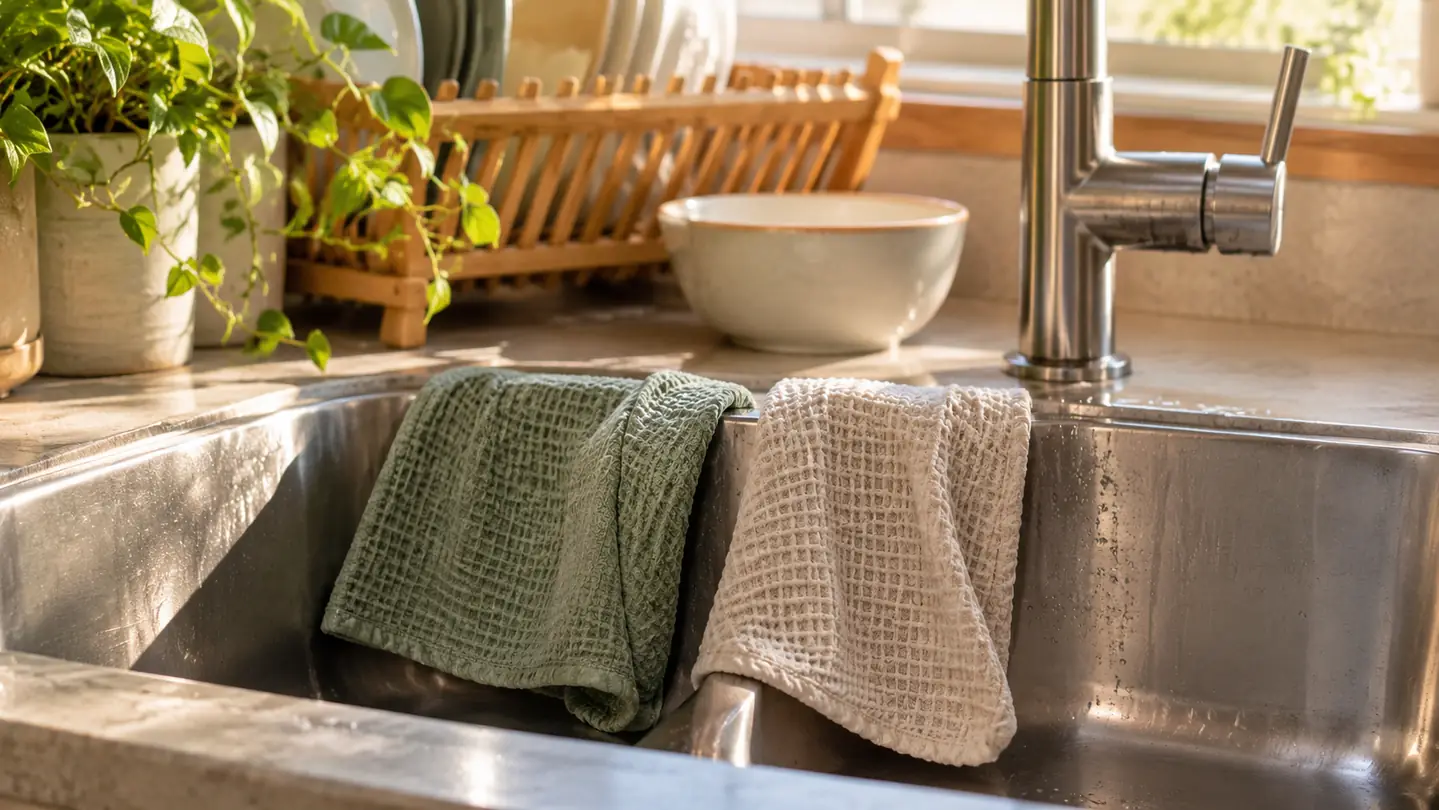
The routine that failed for me was the one that involved a bucket of anything. The routine that stuck is a small bin under the sink and one rule: a cloth that has done its job goes in the bin, not back on the counter. When the bin is full, the whole thing goes to the kitchen. The cloths are dishwasher safe, so most of mine ride in the top rack clipped to a tine, and the rest go through with a load of towels in the washing machine. I have not hand washed one yet.
Drying is where the smell lives. A cloth bundled up in the sink overnight, in a warm kitchen, will smell like a wet dog by morning even though these are made to resist odor. Lay it flat over the sink divider, hang it by a clip, or drape it over the neck of the faucet. Once a month or so I pour boiling water over the used ones in a bowl and let them sit while I do something else, then wash as usual. That is the whole maintenance routine, and it takes about as long as reading this paragraph.
How long they last is the honest question. My Eulnars cloths have been in daily rotation since last winter, going through the dishwasher most weeks, and the ones that get the most work are thinner and softer now than the ones still folded in the drawer. None of them have come apart, and none have gotten to the point where I minded using them. When a cloth finally retires from the kitchen, it goes to the garage rag pile and then to the compost, because the material is cellulose and cotton. That last part is what convinced Nora, and she is not easy to convince.
Step 5: Decide Where Paper Still Earns Its Place
I still buy paper towels. I want to be honest about that, because nearly everything I read when I started made it sound like a clean break, and mine was not. The roll lives on the top shelf of the pantry now instead of on the counter, and it comes down for three things: raw poultry juices, draining bacon, and a house full of people on a holiday weekend when there are eight hands in the kitchen and nobody wants to sort out which cloth is clean.
That is not a failure. Going from twenty four rolls a year to a four-pack twice a year is most of the way there, and the reason it held is that I stopped insisting on all or nothing. My first attempt fell apart because I threw out the paper towels on a Sunday and bought them again on a Thursday. The second attempt fell apart because I bought two cloths, ran out, and gave up. Eight cloths and one roll on a high shelf is the arrangement that has now survived a year.
If you are the sort of person who can go cold turkey, more power to you. If you are not, keep the roll and put it somewhere inconvenient. That extra trip to the pantry shelf is the whole point. Most of what I used paper towels for was not worth the walk, and that turned out to be the most useful thing I learned from a fifteen-year-old with a pencil and a week of free time.
What Else Helps
The cloth handles the counter and the sink. Everything else in my kitchen had to shift an inch to make room for the habit. A small compost bin on the counter left of the sink mattered more than I expected, because the scraps that used to get blotted on a paper towel and dropped in the trash now go outside to the pile behind the raised beds. Caleb carries it out when he visits, mostly because he is twelve and likes being useful, and the empty bin gives me one more reason not to reach for paper.
Two other small things. A sheet of beeswax wrap handles the half zucchini and the cut end of a block of cheese, which is a job I used to do with a paper towel and a rubber band. And a second dishcloth lives in the garden bucket, so I am not carrying a clean kitchen cloth out to the raised beds and then bringing clay back inside with it. The Eulnars set is the kitchen drawer; the two that have gone thin get demoted to the garden and the garage. None of this is complicated. It is just the difference between having a system and having good intentions.
Start with eight, keep one roll on the shelf, and see where you land in a month
The Eulnars Swedish dishcloths come as an 8-pack with clips, they go through the dishwasher, and mine have been in daily rotation since last winter. If you are going to try this once, try it with enough cloths that running out is not an option.
Amazon Check the 8-pack on Amazon →