
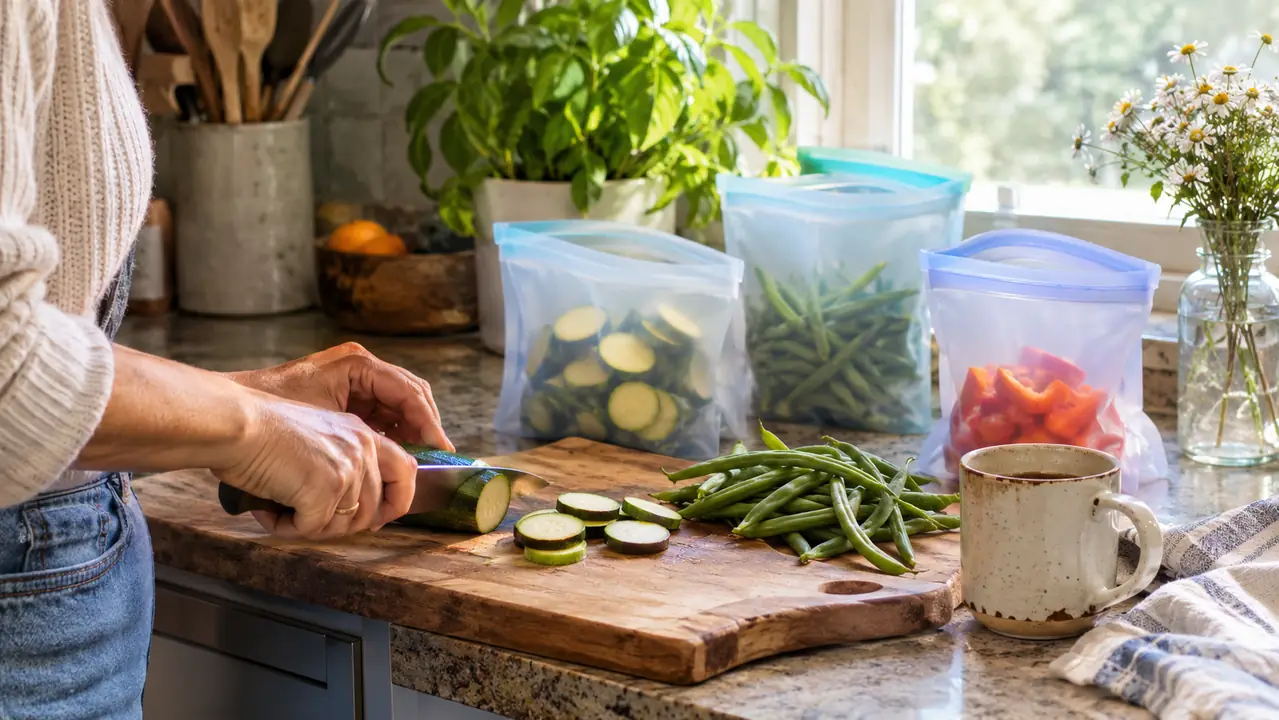
I did not set out to change how my kitchen runs. My granddaughter Nora did it for me. She was fifteen last spring, home for the weekend, and she pulled open the drawer beside the sink and started counting my zip-top bags out loud like a referee at a swim meet. She got to forty-one and stopped, and then she looked at me the way only a teenager can, which is to say with pity and a plan.
I am not an activist. I am sixty-eight, a retired school librarian, and I live alone in a split-level house in Loveland, Colorado. What I am is a person who hates buying the same thing over and over. So I bought a Stasher 4-pack of reusable silicone bags last spring, mostly to get Nora off my back, and I have used them nearly every day since. Here is the honest version of what worked, what I got wrong in the first month, and how I would do it again if I were starting from your kitchen instead of mine.
Start with the 4-pack, not the drawer full
One half gallon, two sandwich, one snack. That is enough to find out whether you will actually keep up with them before you spend real money on a cabinet's worth.
Amazon Check Today's Price on Amazon →Step 1: Count what you throw away before you buy anything
Nora's count was the whole exercise, and I nearly skipped it. Forty-one bags in a drawer I had not inventoried in years, and I was still buying more because a box was on sale and I had no idea what I already owned. You cannot fix a habit you have never measured.
So do the boring thing first. Take everything out of the drawer. Count the zip-tops, the produce bags, the cling film box, the sandwich bags. Write the number on the back of an envelope and tape it inside a cabinet door where you will see it. Mine was forty-one, and that number is the reason I kept going when the seals annoyed me.
Then look at what those bags were actually doing. In my house it was three jobs: a sandwich in Caleb's lunch, half an onion going soft in the refrigerator, and green beans from the garden going into the freezer in August. Once I saw that, I stopped thinking about bags in general and started thinking about three specific jobs I needed to solve. That is a much smaller problem. The Stasher listing claims one bag replaces 260 single-use plastic bags a year. I read that as catalog talk until I did my own arithmetic: one sandwich bag a day in a lunchbox, five days a week, thirty-six school weeks, and that is 180 right there before I count a single thing from the garden.
Step 2: Match the bag to the job, not the other way around
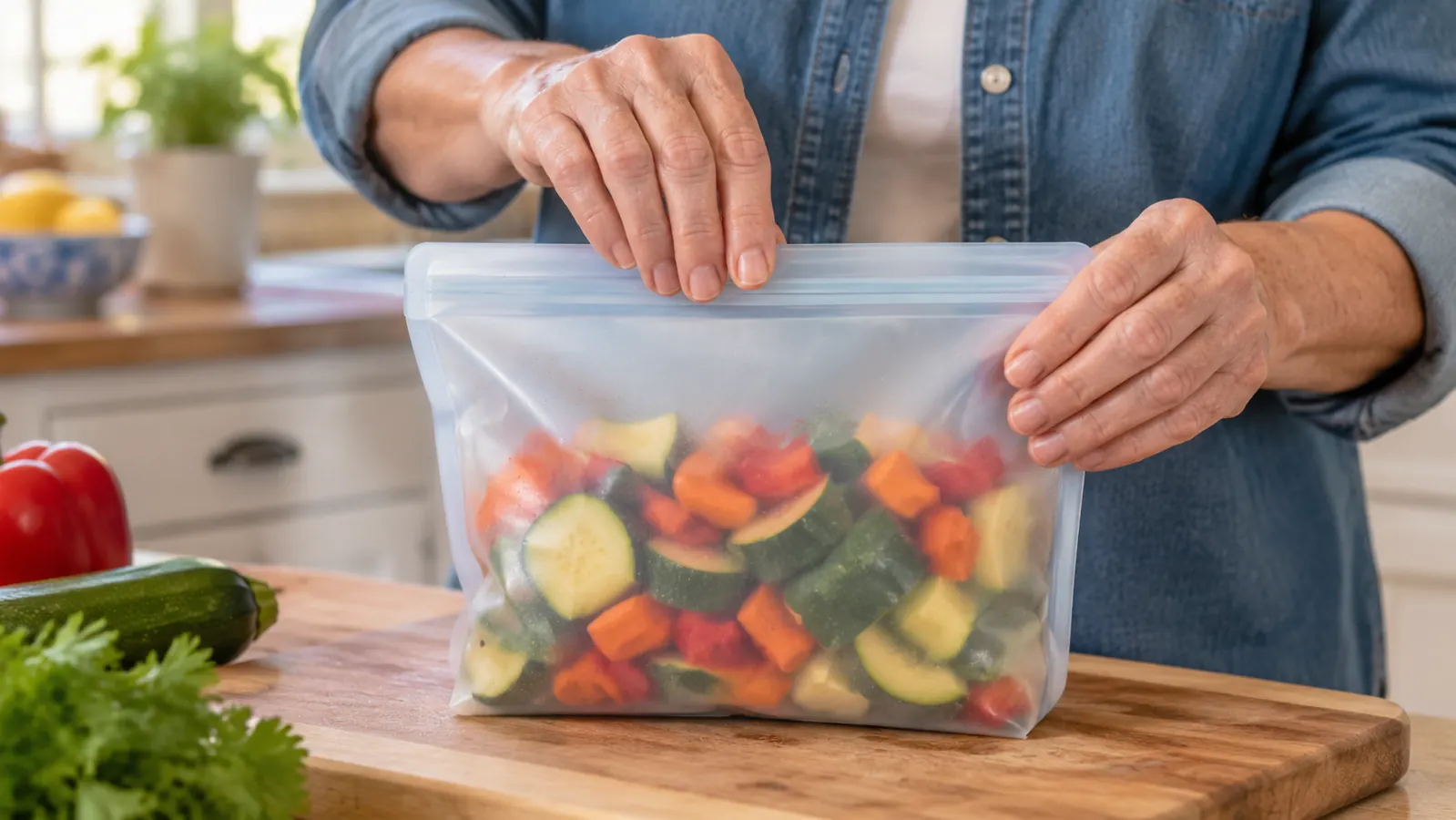
The 4-pack is not four of the same thing, which took me about a week to appreciate. You get one half gallon bag at 64 fluid ounces, two sandwich bags at 28 fluid ounces each, and one snack bag at 12 fluid ounces. If you buy without noticing that, you will end up forcing a sandwich into the half gallon and wondering why the whole idea feels clumsy.
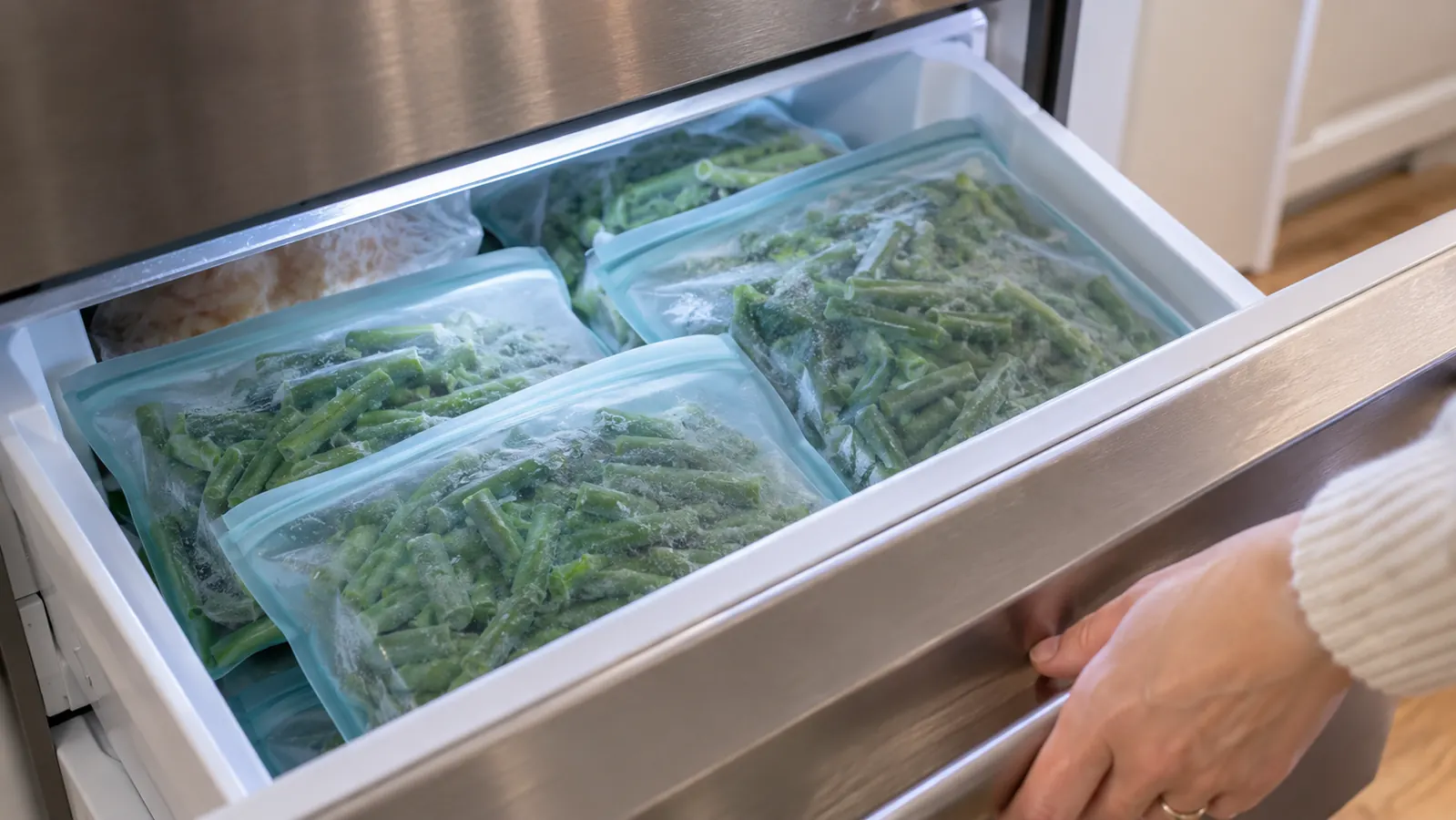
Green beans are what the half gallon bag is for in my house. Three raised beds behind the patio, a short Colorado season, and one week in August when everything comes ripe at once. I blanch them, spread them on a towel until they are properly dry, then lay them flat in the half gallon and stack it in the freezer. It holds a good picking. In February, when the seed catalogs arrive and the ground is frozen solid, I will be glad I did it.
The two sandwich bags go to Fort Collins in Caleb's lunchbox on Sunday night and come home empty, which is the only review that matters from a twelve-year-old boy. The snack bag is the sleeper of the set. I reach for it without thinking: cherry tomatoes from the patio pots, cut herbs, the last of a block of cheese, a handful of crackers to keep in the car. Small bag, most-used bag. Nobody tells you that when you are staring at the box.
Step 3: Learn the seal before you trust it with anything wet
The closure is a press-together track that seals itself, and it is airtight and leak resistant. Note the word resistant. In my first week I filled one with leftover soup, laid it on its side in the refrigerator overnight, and spent a cheerful twenty minutes wiping down a shelf at seven in the morning. Nothing was wrong with the bag. I had asked it to do a job that was not its job.
The habit that fixed it takes three seconds: run your thumb along the entire length of the seal, corner to corner, and pay attention. If you have missed a spot, your thumb will find it before the refrigerator does. For anything headed to the freezer, press most of the way, push the air out with the flat of your hand, then finish the seal. Flat bags freeze faster and stack better, and I have stopped chiseling things apart.
I do not put thin liquids in silicone bags anymore. Soup, chili, stock, those go in glass jars with lids. Chunks, halves, grains, sandwiches, cut vegetables, and herbs go in the bags. That one distinction is the difference between loving these things and stuffing them in a drawer by June. If you take nothing else from this article, take that.
A sandwich bag a day in a lunchbox, five days a week, thirty-six school weeks, and that is 180 bags before I count a single thing from the garden.
Step 4: Wash them the same day, and dry them where air can reach
Mine go in the top rack of the dishwasher. That is what happens nine times out of ten, and it is the reason I have kept up with them. Warm soapy water works fine too, but the real trick is the drying rack: turn each bag upside down over a prong or the handle of a mug so the opening stays wide and air moves through. A bag that dries open lasts. A bag that dries folded over does not.
What went wrong, in case you are about to do the same thing: for the first two weeks I balled them up wet in the dish drainer at night and they smelled like a gym bag by morning. Silicone holds a smell when it cannot dry. Once I gave them air, the problem vanished and has not come back in nearly a year of steady use.
The manufacturer says the bags are safe in the dishwasher, the microwave, and the oven up to 425 degrees. I use the microwave for softening butter and reheating a plate of leftovers, and I have never once tested the oven limit, because I do not need to and I would rather not find out the hard way. Eleven months in, my four bags still close, the corners have not split, and the half gallon has not stained from tomato sauce the way I expected. They look used. That is fine. So do I.
Step 5: Move one drawer at a time, not the whole kitchen
Here is where I went wrong, and it is the part I would change if I could start over. I bought the Stasher bags, cleared out the zip-tops in one satisfying afternoon, and then spent a week being quietly furious every time I needed to wrap half an onion or cover a bowl of dough. I had removed things faster than I had replaced them.
One drawer at a time. Start with the lunch drawer, because that is the routine you repeat most and the one that builds the habit. Then the freezer, while the garden is still producing. Then produce storage. Give each one a couple of weeks before you touch the next. It is slower and it sticks, which is the only kind of change that lasts past the first flush of good intentions.
And keep the things that still work. I still own a roll of cling film for a bowl of rising bread dough, and I still buy one box of zip-top bags a year for the freezer, down from six or seven. Perfection was never the point for me. Nora counted forty-one bags in that drawer. This spring I counted four silicone ones and a nearly empty box, and I felt like a woman who had gotten somewhere.
What Else Helps
Bags were the first domino but not the only one. Bee's Wrap came into the house last summer when the zucchini arrived faster than I could eat it, and it handles the half-cut squash, the cheese, and the bread that used to live under plastic. I wash it in cool water, air dry it on the rack, and it has held up fine. The countertop compost bin I bought last March sits to the left of the sink and takes the peels and the coffee grounds out to the pile behind the raised beds, which Caleb carries out for me on weekends. In the winter I swapped paper towels for a stack of Swedish dishcloths, and they go through the dishwasher with everything else. None of it required a personality change. It required a spot for each thing so I would not have to think about it at six in the evening.
The other thing that helped was glass jars, and they were already in the basement. Anything liquid goes in those. Sheet pans with a lid handle the rest. The point is not to buy your way out of plastic in one shopping trip. The point is that each of these has one job, and after a month you stop noticing you are doing anything differently. That is when it becomes permanent.
Who This Works For
This works for someone with a lunchbox in their life, a garden that overshoots in August, or a freezer that fills up every fall. It works for a person who will run their thumb along a seal and put a bag on a rack to dry. If that is you, the Stasher 4-pack is a sensible first purchase because the sizes cover the three jobs most kitchens actually have, and because after eleven months mine are still doing those jobs. If you want a system that holds soup, buy jars instead and save yourself the morning I had. If you are the kind of person who needs everything to be perfect by Friday, start with one bag and one drawer, and let the rest wait until you have a reason.
Forty-one bags in the drawer, and now there are four
The half gallon, two sandwich, one snack. Mine have been through the dishwasher, the freezer, and a full green bean season, and I would buy them again.
Amazon Check Today's Price on Amazon →