
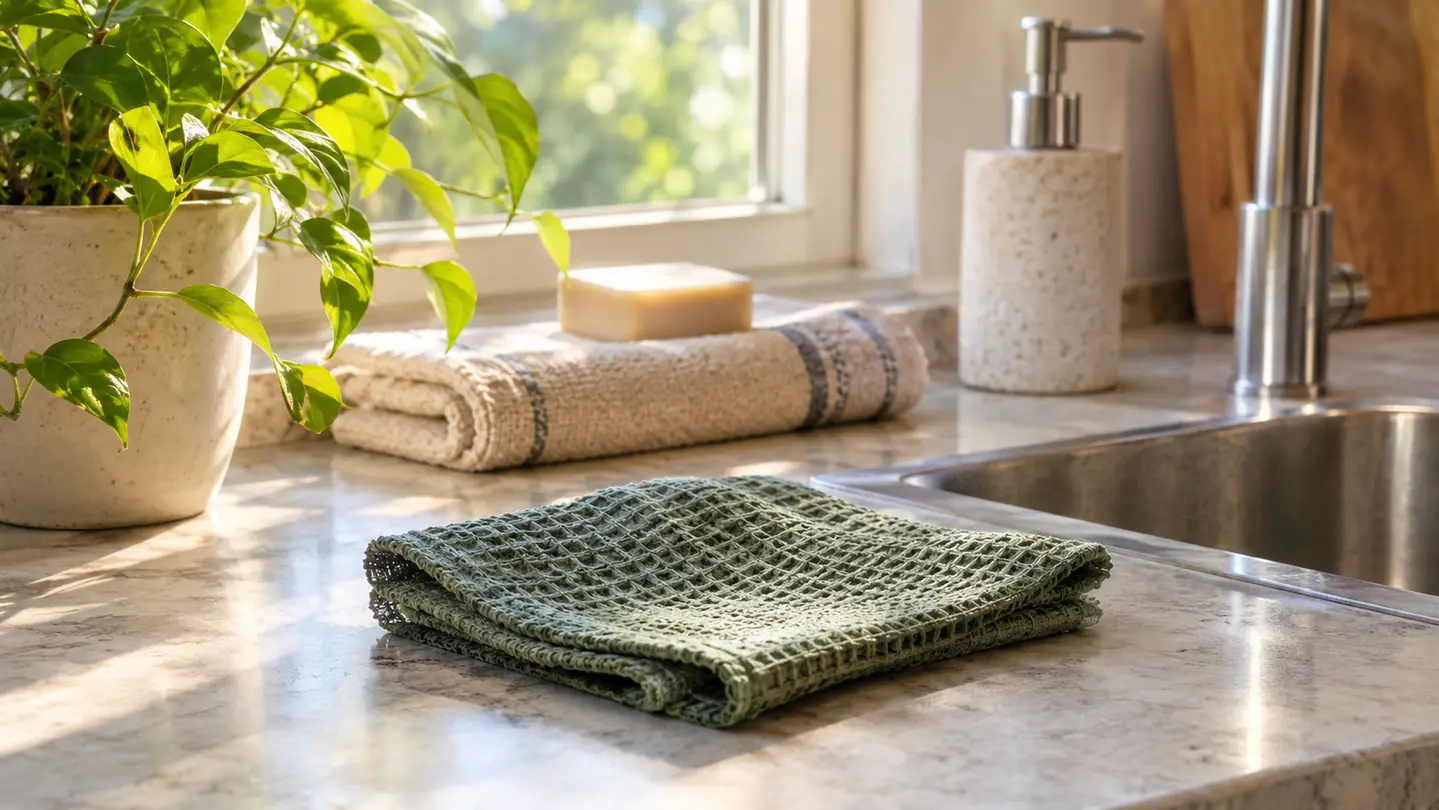
Last winter I bought the Eulnars Swedish dishcloths for one reason, and it was not because I love the planet. My granddaughter Nora, who is fifteen and has appointed herself the recycling police of this family, stood in my kitchen and counted the paper towels I had just carried in from the Subaru. Then she asked me how many trees that was. I did not have an answer. So I ordered the eight pack the next morning and told myself I would give them one honest try. That was nine months ago. Most of the paper towels have disappeared from this house since, and I have opinions.
This is the version of the review I would have wanted to read before I spent anything. Not the one where everything is wonderful. Some of what these cloths do genuinely changed how I clean a kitchen, and some of it annoyed me enough to say so on paper. I am sixty-eight, I live alone in Loveland, Colorado, I cook most of my own meals, and I keep three raised beds out back. My hands are in a sink a dozen times a day. Nobody sent me these and nobody asked me to be kind about them.
The Quick Verdict
They soak up more than a paper towel and they survive the dishwasher. They wear out faster than the advertising suggests, and a damp one left crumpled in the sink overnight will smell by morning.
Amazon Check Today's Price →Eight cloths in a flat envelope, and no more paper towels on the grocery list
The pack I bought last winter is still in rotation in my kitchen drawer. If you are tired of writing paper towels down every single week, this is the simplest place I know to stop.
Amazon Check Today's Price on Amazon →How I Ended Up With Eight of Them
The Eulnars pack arrived flat, like a thin book, and I remember thinking that was a strange way to ship something meant to wipe a counter. Inside were eight cloths and a small set of clips. The cloths are about 7.8 inches square, thin, and stiff as a cracker straight out of the wrapper. I nearly wrote the whole purchase off right there on the counter.
Then I wet one. That is the entire trick and nobody tells you. Run a dry Swedish dishcloth under the tap and it goes soft in about four seconds, like a sponge that decided to become fabric. Wrung out, it stays soft while you work. When it dries again it goes stiff and a little wavy at the edges, which looks alarming and is completely normal.
I have since learned to read that stiffness as a signal rather than a problem. A stiff cloth is a dry cloth, and a dry cloth is a clean cloth. My first month I kept thinking I had ruined them. I had not. The starchiness comes right back out under the faucet every time.
The clips confused me at first. They are small and I could not work out what problem they solved. I now keep one clipped to the inside of the cabinet door under the sink, holding a cloth where it can hang flat instead of balling up in the bottom of the basin. The rest live in the drawer with the potholders. It is a small thing that turned out to matter more than I expected, because drying flat is what keeps these from smelling.
What They Do Better Than Paper Towels
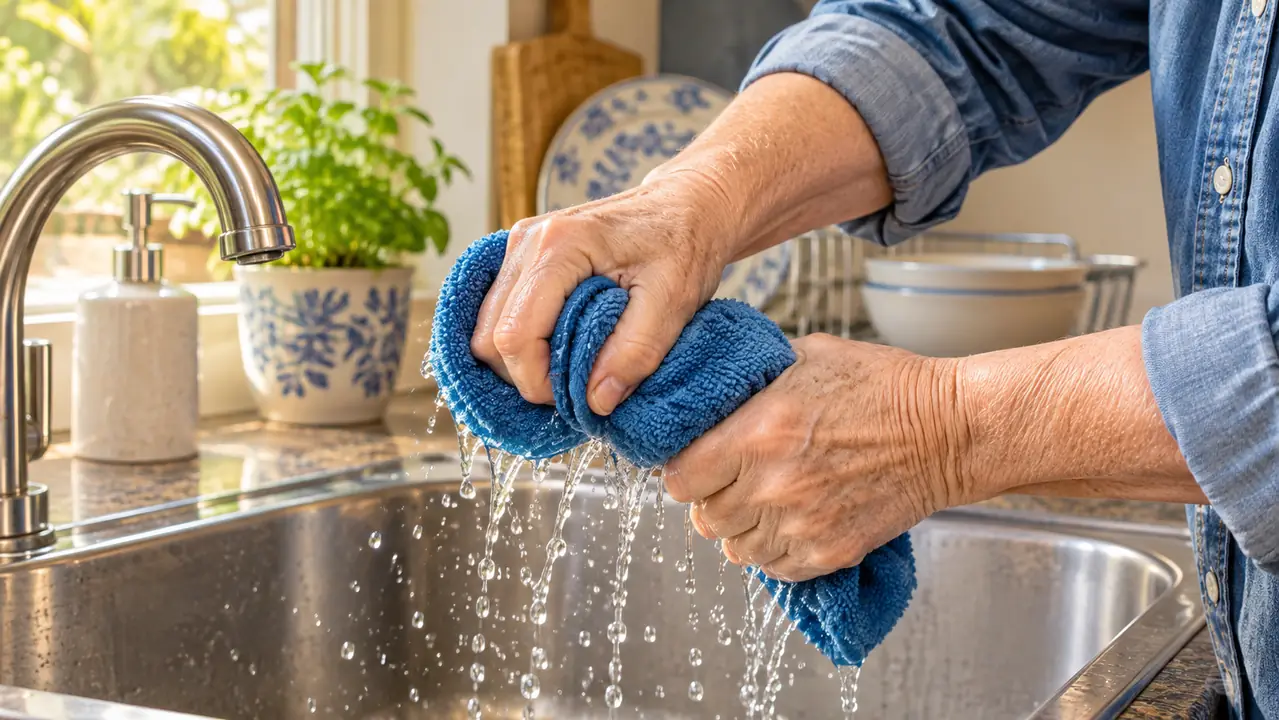
The absorbency claim is the one I expected to be exaggerated, and it is not. A Swedish dishcloth will take a full cup of spilled coffee off a counter in one pass and leave the surface dry enough to set a book down on. A paper towel takes three or four sheets to do the same job and leaves lint behind. I have wrung one of these out over the sink and watched it come back for more, which is not something I ever said about a paper product in my life.
The clearest test came in July, when Caleb set a full glass of milk down on the counter, turned around, and took it out with his elbow. It went across two feet of countertop and over the edge onto the floor. I had one cloth in my hand and a paper towel roll on the wall. The cloth took the counter in two passes. The floor took a bath towel, because a cloth that size was never going to handle a spreading puddle, and that is a fair criticism rather than a failure of the product. What struck me was that I never had to stop and go back for a second and third sheet while the milk ran toward the drawer fronts.
I am not a numbers person, but the arithmetic here convinced me. Before, a roll of paper towels lasted me about three days. Now a roll lasts close to three weeks, and the only reason I buy them at all is for the microwave and for draining bacon. That is the whole case, really. Nine months, six cloths still in the kitchen rotation, and a grocery list that does not say paper towels every single week.
They also turned out to be better at the ugly jobs than I expected. I keep one in the bucket by the back door for wiping mud off the garden tools, and another on the patio for the pots. A paper towel shreds on a wet terra cotta rim. These do not. I rinse one off with the hose, wring it out, and it is ready for the next pot.
The Habit Change Is the Hard Part
I want to be honest about the first two weeks, because I nearly gave up. A paper towel is something you throw away, so you use it without thinking. A cloth is a small decision every single time. You wipe, you fold, you decide whether this one has one more pass in it, you wring it out, and you have to put it somewhere sensible. That sounds trivial written down. It felt like a nuisance in the middle of cooking supper.
Before I worked out the clips I tried a few things that did not work worth a nickel. I draped a wet cloth over the faucet neck first, which left a puddle on the sink deck and a water mark along the caulk that is still there. Then I tried folding them over the divider between the two basins, which worked until somebody bumped the faucet and knocked one straight into the dishwater. Hanging it flat inside the cabinet door was the third attempt and the only one that stuck, mostly because the cloth drips into nothing and is dry by the next meal.
Somewhere in the third week it stopped being a decision. I do not remember the exact day. I just noticed I was reaching for the cloth under the sink without thinking about it, the same way I reach for the coffee tin. What made the difference was having eight of them. When three are in the wash or the dishwasher, there is always a dry one in the drawer, so I never had to choose between a soggy cloth and a paper towel.
That is the part I would tell anyone considering these. One cloth is a novelty. Eight is a system. The pack size matters more than I would have guessed.
The Parts Nobody Mentions
Here is the first thing the product page will not tell you. A Swedish cloth left damp and crumpled at the bottom of the sink overnight smells like a wet basement by morning. Not faintly either. These are made from 70 percent cellulose wood pulp and 30 percent cotton, and cellulose holds water, and wet cellulose sits there and gets to work becoming a science experiment. The fix is easy once you know it. Rinse, wring it out hard, and leave it somewhere it can dry flat. Do that and mine have never once smelled.
Second, they stain and they keep the stain. I have one that took the mark of a pot of chili in February and still wears it in August. It is clean, it does not smell, and it works exactly as well as the others, but it is not a cloth I would hang where guests could see it. Nora spotted it in April and asked whether I was going to throw it out. I said no and then proved the point by soaking up a spill with it. The tomato had gone into the fiber and set, and neither the dishwasher nor a hot wash moved it. What I have learned since is that the marks land hardest on the cloths used for tomato sauce and for beet juice out of the garden, and hardly at all on the ones used for water and dish soap. If a presentable cloth matters to you, keep one aside for the visible jobs and let the others take the abuse.
Third, they are small. About 7.8 inches square sounds perfectly reasonable until you knock over a glass of water on the floor and realize you are going to need two of them, or a great deal of folding. For counters, sinks, faces, and small spills they are the right size. For a wide plank floor, a paper towel or an old bath towel is honestly the better tool.
Fourth, they hold onto grease better than paper does, which is mostly good and occasionally not. Wiping down a cast iron pan, the cloth grabs the fat and hangs onto it until you wash it properly. That is fine. It does mean that the cloth you used on the skillet is not the cloth you then use on the counter without a rinse first.

Nine Months In: What They Actually Look Like Now
I bought these in the winter and it is now late summer, so call it nine months of daily use. Of the eight, two have gone to the rag bin under the sink. One of those developed a hole in the middle after months of scrubbing a cast iron pan, and the other had simply gone thin and limp and stopped absorbing well. Six are still in the kitchen rotation, and I expect them to get through the winter, maybe longer.
The one that holed was the cloth I kept by the back door for the garden. I had been using it on the rims of the terracotta pots, and terracotta is rough in a way a kitchen sink never is. It wore through in the middle, right where my thumb pressed hardest. The limp one was in the kitchen rotation from the start and simply got used more than its share, because it was the one nearest the sink and therefore the one my hand found first. Both went in the same week, in early August, which I am fairly sure is coincidence rather than a pattern.
The pattern has faded on the ones I use most. The edges have gone soft and wavy. None of them have come apart, because there are no seams to come apart, which I suspect is why they hold up as well as they do. When one finally goes, it goes all at once. It stops picking up water and starts pushing it around the counter instead, and you know within a day that it is finished.
Cleaning really is as easy as advertised. The Eulnars cloths go through the top rack of my dishwasher with the supper dishes two or three times a week, and through the washing machine with a load of towels when they need more than that. I have never had one come out of the dishwasher damaged. I have never had one leave lint on a glass.
The clips, nine months on, are the part I am least impressed with. Mine are small and two have already gone missing, which may say more about my kitchen drawer than about the clips. The cloths are the point of the purchase. The clips are a nice extra that I would not pay anything extra to have.
What I Liked
- Takes a full cup of spilled coffee off a counter in one pass, with no lint and no second sheet
- Survives the top rack of the dishwasher and the washing machine without fraying or coming apart
- Goes soft in about four seconds under the tap and stays soft while you work
- Eight in the pack, so there is always a dry one while the rest are being washed
- Handles wet terra cotta pots and muddy tools without shredding the way paper does
Where It Falls Short
- Two of my eight were finished after nine months of daily use
- Left damp and crumpled in the sink, they smell by morning
- They stain and keep the stain, so they stop being presentable long before they stop working
- About 7.8 inches square is small for a floor spill
- They dry stiff as a cracker, which takes some getting used to
Nine months in, two of my eight cloths have gone to the rag bin. The other six still take a full cup of spilled coffee in one pass.
Who This Is For
This is for the person who is tired of writing paper towels on every grocery list. If you cook at home most nights, if your hands are in the sink constantly, if you keep a garden and you are forever wiping mud off something, these will earn their spot in the drawer inside the first week. It is also, frankly, a good purchase for someone whose granddaughter has started counting things in the shopping cart. Nora has not lectured me about paper towels since last winter.
It suits a dishwasher especially well. I know people who wash theirs by hand and are perfectly content, but the dishwasher is what makes these feel effortless to me. Rinse, wring, top rack, done. That is the entire maintenance routine and it takes about six seconds.
Who Should Skip It
Skip these if you want something that stays looking new. They are workers and workers get marked. Skip them if you have a big household with big spills and no patience for folding a small cloth in half. Skip them if you know yourself well enough to know that anything requiring a rinse and a place to dry will end up in a wet heap at the bottom of the basin, because you will get about a week out of them before they turn on you.
And skip them if you are hoping a cloth replaces basic kitchen sense. These absorb, they do not disinfect. A cloth that has wiped a raw chicken board still needs to go in the wash before it goes anywhere near the salad bowl. I keep a separate cloth for meat and it goes straight to the machine.
Finally, skip them if you need one cloth to handle a whole kitchen floor spill. Buy a mop. These are a counter, sink, and small mess tool, and they are very good at that. They are not a towel and they are not pretending to be.
Nine months, six cloths still in the drawer, and a much shorter grocery list
I did not expect to still be using these in August. If you are ready to stop buying paper towels three rolls at a time, start with the eight pack, hang a dry one inside the cabinet door, and give it two weeks before you make up your mind.
Amazon Check Today's Price on Amazon →