
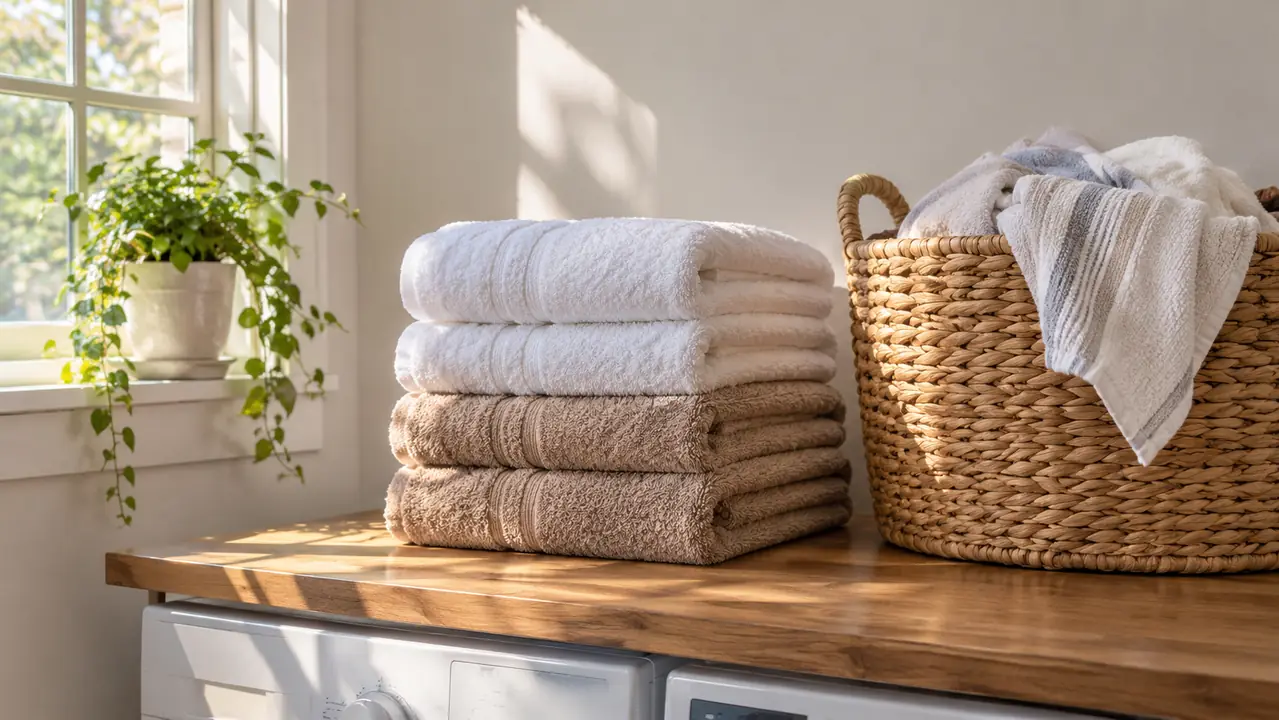
Dryer sheets were the last thing in my laundry room I ever thought about, which is probably why my granddaughter found four boxes of them in the cabinet under the sink. Nora is fifteen, and she appointed herself the recycling police of this house about two years ago. She counted the sheets in one box, did the arithmetic on the back of an envelope, and set it on the kitchen table in front of me. Two hundred and forty sheets in a box. Five or six loads a week in this house. I did not have a good answer for her.
That envelope sat on the table for a week. Then I did what I usually do, which is buy one thing and see whether it earns its place. Last fall I bought a six-pack of Smart Sheep wool dryer balls and put them in the dryer on a Saturday with a load of bath towels. No sheet, no liquid softener, no vinegar in the wash. I stood there with the door open afterward, waiting to be disappointed. The towels came out soft, and the load was done sooner than I had planned for.
I have used them on every load since. It is not a complicated swap, but there are five things I had to learn the slow way, and one of them is that a wool dryer ball can only do its job if you stop packing the drum like a suitcase.
Six balls replaced the whole shelf under my sink
Smart Sheep wool dryer balls, set of six, 100% New Zealand wool with no fillers. No sheets, no liquid softener, and nothing to buy again next month.
Amazon Check Today's Price on Amazon →Step 1: Count What You Are Actually Throwing Away
Before I changed anything, I counted. Five or six loads a week is normal here, more when Caleb stays for a week in the summer. He is twelve, he plays baseball, and he can go through three shirts in a day without trying. Call it two hundred and sixty loads a year. One sheet per load, sometimes two. That is a box and a half a year going into the trash one sheet at a time, plus the bottle of liquid softener I used to buy for the towels.
The week I actually counted was the second week of October, the week the furnace came on for the first time. I kept a notepad on the shelf above the washer with five tally marks drawn across the top, one for each load, and I made a mark before I moved anything from the washer to the dryer. Sunday night I added the row up: six, six, five, seven, six, five, four. Thirty-nine loads in seven days. I had guessed thirty before I started, and I was wrong by a quarter. Then I multiplied by fifty-two anyway, because a quiet week in October is not a week in July when Caleb is here and the towels go in twice a day.
The reason that number was worth writing down is not the money, though there is some. It is that the waste was invisible. You never see the pile. You see an empty box, and then you flatten the box and put it in the recycling and feel fine about it. Nora's point, delivered with the full moral confidence of a fifteen-year-old, was that the sheet itself was the problem, not the cardboard.
Write your own number down. Loads per week times fifty-two times the number of sheets you actually use. Mine was two hundred and sixty. Yours might be ninety. Either way it is a real number, and it is the number the wool balls have to beat before the swap is worth the trouble of changing a habit you have had since the Carter administration.
Step 2: Match the Number of Balls to the Size of the Load
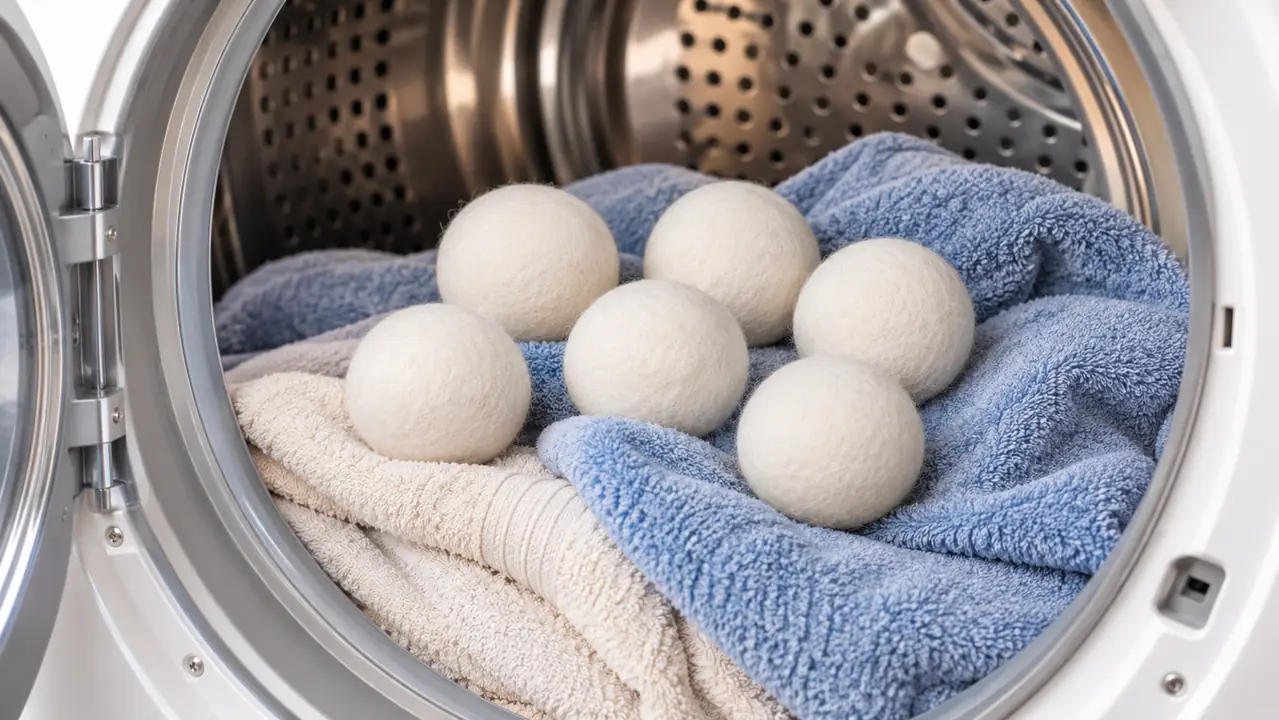
The package says three balls for a small or medium load and five or six for a large one, and that turns out to be exactly right. Three balls go in with a normal weekday load of shirts and underwear. Five go in with the towels, the jeans, or the bed sheets. I have run all six at once and it works, but it is not necessary and it makes a racket against the drum.
The mistake I made first was assuming more balls must mean softer laundry. They do not work that way. The balls need to fall down through the fabric as the drum turns, and six of them in a small load spend most of the cycle bouncing off each other instead. Three in a load with some room will do more than six crammed in with a full drum.
I keep a small basket on the shelf above the dryer. The three I use most live there and the other three wait for towel day. Having them out where I can see them is the whole reason the habit stuck. Dryer sheets lived in a cabinet I had to open, behind a bottle I had to move. Wool dryer balls sit in a basket I walk past with a wet load in my arms.
Step 3: Load the Drum So the Balls Can Actually Move
This is the step that decides whether wool dryer balls work for you or end up in a drawer by February. The drum needs air. Two-thirds full is my limit, and that is looser than I used to load it, because for thirty years I treated the dryer like a packing problem and the washer like a race.
The day I learned this, I had Caleb's baseball uniform, two bath towels, and a set of queen sheets all in one drum because I wanted to be finished before his game started. Forty minutes later the sheets were still damp in the middle and the uniform was hot enough to sting my hand. I pulled the sheets out, put them back in a drum that was two-thirds full with three balls, and they were done in thirty minutes. Same machine, same balls, different load. He made it to the game with four minutes to spare and I have not done that to myself again.
Heavy things go together. Towels with towels, jeans with jeans. A mixed load of heavy towels and light cotton shirts will always leave the shirts damp and the towels overdone, and no dryer ball on earth fixes that. That was true with sheets and it is true without them.
Clean the lint screen every single load. I know. But a clogged screen stretches drying time, and if drying takes longer than you expect you will decide the balls do not work when the truth is that the screen is full of felt. Three seconds with your fingers before you close the door. I have now said this twice in one article because I have now forgotten twice in one month.
Step 4: Retire the Sheet Habit, Static and All
Here is the honest part, and it is the part I would want someone to tell me. Wool dryer balls do not kill static the way a dryer sheet does. In January in Colorado, with the furnace running and the air dry enough to snap, a load of polyester fleece will still crackle when you pull it apart. Cotton and wool come out fine. Synthetics can be a nuisance, and I am not going to pretend otherwise.
My first attempt to fix that was half a cup of white vinegar in the rinse cycle, which is the advice everybody gives. It helped the towels. It did nothing at all for the fleece. My second attempt was a damp washcloth thrown in with the load, which is the other advice everybody gives, and that one worked well enough that I still do it on blanket day. A washcloth is not a purchase and it is not a sheet, which is the whole point.
What helped most was taking the load out while it was still a touch damp, especially the fleece blankets. Overdrying is what makes static worse, and I had been overdrying for years because I set the timer and walked away. The other thing I had to adjust to was the smell. Smart Sheep wool dryer balls come unscented, and for about two weeks my towels smelled like nothing at all, which felt wrong in a way I did not expect.
Then I put one drop of lavender oil on one ball, rubbed it in with my thumb, and let it sit for an hour before it went back in the basket. One drop, one ball, not the whole set. That was enough to take the edge off. If there is a baby in the house or someone with sensitive skin, skip the oil entirely and keep the swap simple. The point of this is fewer things going into the laundry, not more.
Three balls for a Tuesday load, five for the towels, and the drum has not seen a dryer sheet since October.
Step 5: Keep Them Working and Know When to Stop
The listing says a thousand-plus loads and I have no way to test that in a year. What I can tell you is that mine have been through a fall, a winter, and a spring and they still look like wool balls. One of the six has a thread working loose at the seam. I trimmed it with the kitchen scissors and put it back in the basket.
They pick up lint the way a sweater picks up lint, and a minute with your fingers every few weeks keeps them from shedding onto a dark load. I have not put mine through the wash. If they ever get genuinely grubby, my instinct would be a mesh bag and a cold rinse, but I have not needed to try it and I am not going to tell you it is required.
Six balls, five loads a week. That is about two hundred and sixty loads a year, so a thousand loads is roughly four years of my laundry. By then I will be seventy-two and the grandkids will be grown and gone. I like a purchase that outlasts my interest in it.
What Else Helps
Wool dryer balls handle softening and they shorten drying time, but they are one part of a laundry room that wastes less. The rest of it is dull, cheap, and works better than any accessory.
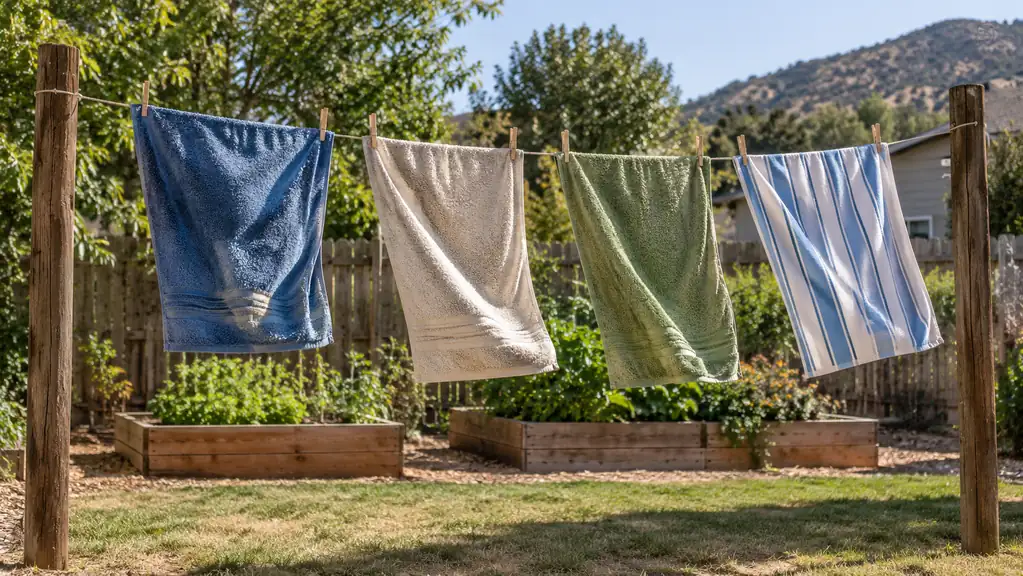
Line dry what you can from May through September. Loveland is dry enough that towels on the line are done in an afternoon, and then five minutes in the dryer with three balls takes the stiffness out of them. You skip most of the machine time and still get a soft towel. The line itself is a pair of wooden posts that have been in the ground since we moved in, and they have held up better than anything else in that yard. Towels go out first thing in the morning. Sheets go out after lunch so they have time. By four o'clock most of it is dry. On hail years I bring it in early and do not argue with the sky.
Wash full loads rather than half loads, use the shortest cycle that gets things clean, and keep the lint screen clean, which I have now mentioned for the third time. A machine that runs forty fewer cycles a year saves more than any product you can put inside it.
Nora still checks the cabinet under the sink every time she visits. The four boxes are there, because I cannot bring myself to throw out something that was once expensive. She has stopped asking me when they are going out, which I take as a sign that the basket above the dryer has made its case.
The swap takes one dryer load to get used to
Smart Sheep wool dryer balls, set of six. Three for a normal load, five or six for towels. No sheets, no liquid softener, and no box to remember to buy.
Amazon Check Today's Price on Amazon →